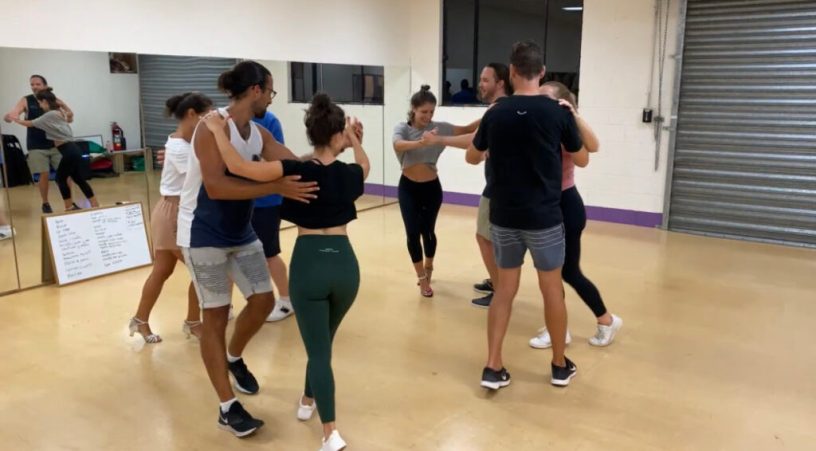
To those who do not want to read an entire blog post, the short answer is: because most casino dance classes focus mostly on the students recalling something instead of them being allowed to create something with what they recall. If you want to explore this idea more in depth, by all means read on.
If you did not know, I am an educator. I teach high-school Spanish. I have been doing it for six years now. Before that, I taught Spanish at the university level for five years. Before that, I taught casino in a student group when I was completing my undergraduate coursework.
I’ve been teaching for a long time, and it all started when I found myself for the first time teaching a beginner’s rueda de casino class. Since then, I’ve taught a lot of casino lessons. Likewise, I have attended many Cuban dance lessons, from many different instructors.
And in most of them (including mine), instructors have simply asked attendees to follow what they were doing, to mimic them. Sure, some instructors explain more than others what they are doing, the technique involved, etc., but the purpose of most social dance classes out there is for the student to recall what the instructor shows that day.
Here is the thing: in the field of education, if you are simply recalling something, you have not truly learned anything.
This is why many people forget all the information they “learned” for a test, after they take the test. They did not really learn it. They simply recalled it for long enough to pass the examination. After that, the information was forgotten. Sounds familiar? Of course it does. We have all experienced it.
This is why there is also this axiom about learning, which you have probably heard already: you only truly learn something when you have to teach it.
Think about a time where you have had to teach something to someone. Chances are, you had to prepare what you were going to say so that someone with no idea of what you knew grasped the concept that you were trying to explain. Chances are, as you prepared–or attempted to teach in real time without preparation–you realized there were things you did not quite understand yet about what you were teaching. But as you talked through it or revisited it later on, you finally did understand.
And, as it turns out, this is all based on concepts from the field of education.
In education, we often use Bloom’s Taxonomy when creating educational goals. Said framework allows teachers to think about how to best maximize the learning experience of their students, based on how cognition works.

According to this model of learning:
- Before you can understand a concept, you must remember it.
- To apply a concept you must first understand it.
- In order to evaluate a process, you must have analyzed it.
- To create an accurate conclusion, you must have completed a thorough evaluation.
Taken from: https://tips.uark.edu/using-blooms-taxonomy/
Unless you are simply regurgitating what someone else said without really understanding what you are saying, to teach is to create, to make something truly your own by explaining it in your own terms, based on your own understanding, application, analysis and subsequent evaluation of that which you are trying to teach. That’s the highest level of Bloom’s taxonomy. That’s true learning. That’s why information that you teach tends to stick more in your brain than information that you simply recall.
Now, with all of this in mind, think about your typical social dance class. How high in the pyramid of Bloom’s taxonomy does it go? Chances are, not very. Chances are, it stays within the first level. Indeed, all most social dance instructors ask you to do is to remember, at the end of the class, whatever turn pattern they taught that day. As an attendee, you often do not have an opportunity to go up the pyramid: to summarize or explain what you are learning, much less to apply what you have learned to something else, or to evaluate how what you are learning goes together with what you already know. Those opportunities for the student simply do not exist in most casino dance classes–or any other type of social dance.
Because of this, students take a long, long time to master a social dance. And it makes sense: they were never allowed to truly learn it.
Some of you reading this might be saying, “Well, if the best way to engage higher-order thinking and truly learn something is to teach (i..e create), wouldn’t that mean that the student would have to become the teacher in order to truly learn something? How is that going to work if there is a already a teacher there? The teacher is not simply going to let a student teach instead of him/her.”
Here is where knowing about actual practices in education pays off: the primary role of a teacher is not to lecture. I can talk your ear off about casino all night, and it won’t mean a thing to you the next day if I gave you no opportunity to do anything with the information beyond remembering. Instead, a teacher should be a facilitator.
The teacher-as-facilitator concept is one with which many teachers in schools are familiar, as the focus of education has moved from being about recalling content, and more about developing skills. In other words, teachers are supposed to facilitate opportunities for students to truly engage with the material and learn it. That means that, ideally, teachers should step back, give control away, and let students teach.
In a Spanish literature class, that may look like me dividing the class into groups, giving each group a task: Create a presentation about a literary movement, explaining XYZ. I would give them guiding questions that they need to answer for themselves as they create the presentation. Additionally, they will answer questions from the audience after the presentation. Students who do this are engaging higher-order cognitive skills–and thus, learning–more than another set of students in another classroom who are simply sitting there, watching the teacher explain a literary movement, and taking notes.
In a casino class, the teacher can step back and let students teach as easily as this:
For next class, you will find a video that you like to watch and, between you and someone else, or on your own, teach to the rest of us a combination spanning no longer than four counts of 8, from that video. When you teach it, you will have to explain how this combination connects to what you have already learned, in what way it is different from what you knew, and in which ways did it help you better understand the dance.
That’s it! It really is that simple. The next class, students, individually or as a couple, will take turns teaching the combination that they learned. Will all students learn this combination as well as they ones who teach it? Probably not. Then again, the objective is not the combination itself, but rather to practice teaching, with all which that requires before you actually teach: remembering, understanding, applying, analyzing, evaluating. Again, the emphasis is on skills rather than content itself.
Now, some caveats about what I suggested above.
- An instructor cannot simply ask the student to teach something if no opportunity has been given to do application, analisys, evaluation, etc., beforehand. Students have to know what that looks like. As such, instructors should incorporate this into their lessons. For instance, simply asking students, “What does this combination resemble that you already know?”. Or saying, “OK, we’re here, but what can we do from here, from what we have learned? Talk to your partner and let’s share in 3 minutes, see what different ideas you all come up with.” See? These practices, so common in the field of education and proven to enhance student learning, are visibly absent when you take a social dance class.
- The 1-hour workshop at a festival or congress does not work for these purposes because said workshop happens in a vacuum. The workshop doesn’t come from anything, and it doesn’t lead to anything. It just is. Therefore, facilitating opportunities for students to teach is better suited for progressive lessons.
Of course, none of the “teacher moves” I have suggested above are by any means exhaustive. There are many, many more things that instructors can do in order to facilitate higher-order thinking. If you are an instructor reading this, start thinking about activities where you cede control and let student voice be more prominent in the lesson.
Finally, with a post like this, I don’t mean to minimize the impact that your teacher has had on you, or that you, as a teacher, have had on your students. What I simply have sought to point out here is that there is little intersection between the field of education and casino dance classes (or any social dance classes), starting with the fact that one does not have to be certified to become a social dance teacher. There is a lot that social dance teachers can learn from current practices in education, and apply in their lessons. To me, it seems like a very big missed opportunity that this is not happening, not only for the teacher, but mostly for the students. I hope that this post encourages some of them to do just that. For students, I hope that this post pushes you to seek opportunities to do more than just try to recall what you were taught.
 Son y Casino
An excellent article. You make very important points. I learned a lot from it. This point in particular: “…students take a long, long time to master a social dance. And it makes sense: they were never allowed to truly learn it.” (Greetings from Miami)
Great article!
I just found your blog and your post is so spot on. I’ve been taking LA style salsa lessons for several months. I’ve progressed far enough that I know the absolute basics, enough to be able to dance socially. The classes I’ve been taking teach a “progressive” lesson over a course of a month. The problem as you have so eloquently written about is learning random patterns and shines do not translate into flow. I’ll attend social dances and often I feel I can’t do any of the things we learn in class. Granted I realize 6 months is a very short amount of time and I have much to learn. Still, the idea that there is a better methodology makes sense.