
Writing about how Cuban dances have been commodified, reshaped, and repackaged outside of Cuba for mass consumption is hard.
What makes it hard is not that these are difficult topics to talk about.
What makes it hard is that people often do not want to listen. If they do listen, they do so wearily, ready to pounce like a tiger in wait for a gazelle that strays from the herd. And they do. Every time I publish something that critiques the state of Cuban dances abroad, I receive my share of negative feedback. In fact, when this past February I attempted to do a month-long “Cuban Salsa Detox” to raise awareness about how casino is authentically danced in Cuba, I received so many personal attacks and microaggressions on my page, that I had to take a month-long break to take care of my mental health. What I have published here since is an extension of the work that resulted from me asking the question, “Why does this happen?”
So why does this happen?
Well, there are many reasons, but in this post specifically, I want to delve into three that I think encompass 90% of the reasons why people do not respond well to these issues. When taken together, these reasons elucidate a clear thesis:
For a lot of people, Cuban dance is a means to an end; that end is rarely Cuban culture.
In this post, then, I will examine the ways in which Cuban dance, and specifically casino, has been reappropriated to meet a series of needs that, ironically, isolate casino from the larger Cuban culture in which it was developed. At the end of this piece, I will provide solutions that hopefully help you rethink, reframe, and put into action different ways in which you can engage with the dance of casino, Cuban people, and Cuban culture at large.
As you read this article, you might feel discomfort. I will ask you to embrace it. Don’t dismiss it. Sit with it. Ask yourself, “Why does this make me feel uncomfortable?” and welcome it as an opportunity to grow.1
Additionally, if you know me and have interacted with me or talked to me, you might feel like I’m specifically writing about you. I assure you, I am not. My observations are a conglomerate of my many interactions with many people. Nothing here is about a single person. It feels personal, take it as what it is: a symptom of a larger problem.
At the end of the day, I do not want to push people away. I want people to listen and normalize these discussions. In a previous article, I analyzed the ways in which Cubans like me are not okay with what is happening to casino abroad, and how they are expressing this discontent in certain spaces. The conclusion was that these discussions need to be normalized because they are part of a bigger conversation about capitalism, globalization, and neo-colonialism, which contribute to the ways in which casino has been affected to the point that what is done abroad has little-to-no resemblance to how casino is danced in Cuba.
By normalizing these conversations, my hope is that we (Cubans and their allies) can truly begin to seek ways to disrupt these systems of power that promote commercialized versions of authentic cultural products.
But to do all of this, we have to be willing to be uncomfortable. We all need to hold up the metaphorical mirror and admit, to the reflection that stares back, that we might be complicit. Change begins with taking accountability. As the axiom goes, the first step in solving any problem is admitting there is one.
By writing an article that summarizes the reasons why people might find it hard to hold themselves accountable, I hope that those who see themselves reflected at any point in what is written here truly take it as an opportunity to grow and become better allies to Cuban culture.
As with anything, we cannot change what we have done. We can, however, change what we do moving forward.
As an important side note before continuing, I would like to dispel the idea that the tone in which something is said constitutes a valid reason to not engage in these conversations. I specifically wrote about this in this article, which I recommend that you read before proceeding.
As a way of summarizing, focusing on the tone of the message constitutes “tone policing,” an oppressive practice that serves to silence people when they raise concerns about how they are being mistreated. As such, tone policing is problematic because a) it evades engaging with the actual contents of the message, and b) it dehumanizes the person by suggesting that what they are feeling is invalid unless it is expressed in a certain way. That “certain way” is usually defined by the people who have created the problem, or who uphold the system that created the problem. In other words, it’s a way to dismiss the message and not take accountability.
Once again, I strongly urge you to read that article before proceeding with this one.
Reason #1: The problematic beginning of many Cuban dance groups
By and large, Cuban dance groups around the globe are disproportionately started by non-Cubans. Now, it is okay to have an interest in Cuban dance culture. What is not okay is thinking that this interest is enough to become a spokesperson for that culture. Sadly, that is a consideration that escapes many of the founders of these groups. Many think that because they took a number of classes and/or traveled to Cuba once or twice, this is sufficient to open up their own Cuban dance academies or groups.
Normalizing the pedagogy of a dance without extensive and intensive study of it is nothing new, however. Indeed, it is part of a proud and century-old capitalist tradition that began when tango was first imported to the U.S. Juliet McMains, who wrote extensively about this in her book Glamour Addiction: Inside the American Ballroom Dance Industry, explains that:
Westernized tangos were similar enough to other ballroom dances to be mastered without extensive study, referencing the Western fantasy of tango as exotic Other primarily by adopting only those elements most easily appropriated. (112, my emphasis).
The way in which many Cuban dance groups get started, then, is an extension of this notion that any dance can be “mastered without extensive study,” that you only need to study for a little bit in order to teach them. Under this paradigm, anyone can be a teacher. And so you get groups that teach “Cuban dance” but do not necessarily know what they are doing (because they haven’t really studied it extensively), or think they are teaching a Cuban dance, but are actually teaching a commercialized version, “codified and redefined…for Western consumption” (McMains 111) while being totally unaware that this is what they are doing.2
I honestly cannot pick which scenario is worse.
The other problematic aspect of the inception of many of these Cuban dance groups is that they are often created without bringing Cubans on board, or even consulting them.
If you are asking yourself why Cubans even need to be consulted in the creation of a Cuban dance group, well, that’s part of the problem. You have internalized the idea that you can take from a culture without asking, which goes all the way back to colonial times. Again, these behaviors are often extensions of larger, systemic issues that have not been truly questioned by the people who engage in these behaviors.
Would you create a group about women’s issues without asking women for their input?
Would you create a group focusing on combating systemic anti-blackness without engaging black people in it?
Would you create a group to spread awareness of the LGTBQ communities’ needs without consulting LGTBQ people?
Of course you wouldn’t. Or at least I hope you would not.
Why is the standard different for Cuban culture? Why do people feel like they can create a Cuban dance group without talking to or involving Cubans before they create the group?
Because that’s what’s been normalized. It’s as simple as that.
And so, when people read or listen to someone who is trying to disrupt these practices, they often do not receive this well. This criticism is not normal.
In the cases that people do receive it well, or at least acknowledge the problematic ways in which their groups began (which is a step in the right direction), what I have seen people often do is argue that, regardless, their intentions are in the right place…which is a step back to exactly where they started.
Folks, the road to hell is paved with good intentions. The saying exists for a reason. 3 For example, during the colonial era in Latin America, many missionaries came to this side of the globe to convert indigenous people to Christianity. In doing so, they often suppressed indigenous cultures because they were not “civilized” enough. At all times, they upheld the system of colonialism, working within it and providing rhetorical “high grounds” to continue committing atrocious acts to people.4
Good intentions can go hand in hand with practices of oppression and erasure. As such, good intentions might hide complicity, as George Yancy points out in this article. Claiming good intentions–and by extent, innocence–does not exonerate anyone from how they are complicit in perpetuating systems of power. Indeed, good intentions can ultimately be part of “the lies that you tell yourself so that you don’t feel the weight of responsibility” (Yancy).
Reason # 2: “It’s just a dance”…and other internalized capitalist shenanigans
When people react to criticism about how casino has been reshaped abroad, one of the push-backs I keep seeing is that casino is “just a dance”. In this line of reasoning, there is no need to get all up in arms about something so trivial as a dance, something that should intrinsically provide joy, not create tension.
What some people often do not consider is that a social dances cannot be separated from the culture in which they were created…and that capitalism has a long history of stripping anything of its culture.
A capitalist system prioritizes money and profit margins over authenticity. The main objective of capitalism within the context of dance is not to create conscious consumers or to promote authentic culture, but rather to amass capital. If that means exploiting people or a culture, that is of no consequence.5 As such, capitalism is no one’s “friend.” It will be on your side if it deems it convenient (i.e. profitable). As soon as the profit margins go down, however, it will drop you like a hot potato.6
Because Cuban dance outside of Cuba is often taught within a capitalist system, people who work within this system and have internalized it, will, more often than not, recycle its premise: amass capital.
To do that, people are logically going to do what accrues the most capital. In the context of the Cuban dance community, this is done in various ways. For starters, the name of the dance gets changed to appeal to more people. I’ve written ad nauseam about how casino is not a “style” of salsa dancing, so I am not going to do that here. What is important to note is how people continue to slap the “salsa” label on casino–even when they know there is a difference–because “that is what sells.” If the salsa label is not used, the argument goes, it is not good for business, as people would confuse it with something else.7 Additionally, many groups and dance academies cater to what is “hot” in the market.8 If people are interested in learning guaguancó in a group that focuses on casino, then instructors are going to find a way to teach guaguancó with casino, even if that is not representative of how Cubans authentically dance in the island.
The emphasis on “selling” something and the concern for “customers” is symptomatic of teaching a dance within a capitalist system. For the vast majority of people teaching anything Cuban, dance is a business.
That casino is part of a larger culture is secondary to the primary concern: the need for the business to survive. And to do that, businesses do what is logical: they try to please the customer so they do not lose them.
Cuban dance students, or “customers,” on the other hand, want a service. They want a space to be themselves, they want to feel like they are part of a bigger community, to get a workout, to meet new people (perhaps a new paramour?), to have something to brag about to their friends, to fulfill a need in their lives, to have fun, to learn something new for learning’s sake.
That service usually serves a personal need. Very rarely does that service entail a desire from the customer to truly engage with the culture.
Just think about the reason why you first went to a Cuban dance class. Was it truly because you wanted to know more about Cuban culture?
With this, I am not saying that you have to become an expert in Cuban culture to learn casino. What I am saying is that you need to be cognizant of the fact that capitalism disassociates dance from culture, or in the best of cases it gives you a false, incomplete idea of a culture through known artifacts (i.e. a Cuban flag hanging in the back of a studio to validate a “timba class” as “Cuban”).9
Under a capitalist system, the dance class is often a conduit to nothing cultural beyond the dance. The class begins with a move. It ends by practicing that move. Where is the history? Where is the education? Where is the culture? It’s…just a dance.
And when people internalize this, they do shit like this:

Or they say shit like this:

* * *
Let me be vulnerable for a moment. I go to Indian restaurants at least twice a month. When I go, however, I do not go because I want to learn about Indian culture. I go seeking one of my favorite dishes: lamb korma. I’ve lost count of how many times I’ve eaten this dish, yet this has not resulted in me being any more versed about Indian culture than superficially knowing what spices they use that are different from what I use. All I can honestly say after eating lamb korma is that I love lamb korma. I can’t claim I love Indian culture.10 Thanks to capitalism, my experience with Indian culture has been reduced to a dish.
In the same way, the same people who have grown to love “Cuban culture” through its dances often do not realize that this experience has been framed as separate from culture itself, and separate from the people of that culture.
In fact, of those of you reading this, who can honestly say that you have a Cuban friend? Mind you, not a Cuban that you are acquainted with, or a Cuban teacher that you see regularly. No. I am talking about a friend. Someone you spend time with outside of dance spaces.
Some people reading this might say, “But how am I going to have a Cuban friend when there are no Cubans in my community?”
And yet there is a Cuban dance group that got started in your community, where no Cubans live.
Can we not see how this is a problem?
I hope that you can. And if this is making you uncomfortable because you are now realizing that you are part of the problem, well, that’s good! That’s how progress happens. It is also why these conversations are hard to have: it makes people feel vulnerable.
Reason #3: Ruedas are symbolic of community only
Arguably, the rueda is the most appealing feature of the dance of casino. It’s what draws most people in, initially, and it is why most people stay. In fact, most of you reading this were likely introduced to casino through the rueda. And who can blame anybody? They look cool, dynamic, and are a lot of fun. It’s hard to resist their pull.
Ruedas make you feel like you are part of something bigger. And you are. Your individual contributions to the rueda are as important, sure, but so are everybody’s. Things do not happen in a rueda because one person wills it. Although there is a cantante who calls the moves, you need to work together with everyone toward a common goal. And when that hard new move or new structure that you’ve been practicing finally comes together, it feels great.
Ruedas, then, are a great way to build a community. It is main appeal, and it has always been, both in Cuba, and outside of it. And while people might initially join a rueda group because they like, aesthetically speaking, what they see, they usually stay for the community that welcomes them with open arms, without judgment or prejudice. The bonds that people create in these groups are often long-lasting, and as strong as vibranium (I know I have a Marvel nerd out there reading this that gets this reference).
Additionally, we could argue that ruedas serve as a sort of disruptor to Western society’s everyday emphasis on individualism. In the United States, as in many parts of Europe, the needs of the individual are prioritized over the needs of the community. 11This can lead to increased isolation and a sense of not belonging anywhere, which has disastrous effects on mental health. 12According to the U.S. Surgeon General, “the mortality impact of being socially disconnected is similar to that caused by smoking up to 15 cigarettes a day,4 and even greater than that associated with obesity and physical inactivity” (4).13 Loneliness and isolation within the U.S. population have reached such a breaking point that in has been, in fact, classified as an epidemic.
It stands to reason that ruedas are so popular in these cultures. For many people, they are a breath of fresh air in a world inundated with the stench of loneliness.
Now, I am not saying that you became interested in the ruedas because you are lonely. I’m simply saying that ruedas inherently help combat loneliness by creating community. Which is true, even in Cuba. Indeed, in Cuba, ruedas play a role in the identity of a province, town, or even a neighborhood, as they are sometimes used to showcase what a set of particular people can do in this formation that others cannot. They are a source of pride and community-building.
But also, this goes back to the thesis of this post: outside of Cuba, Cuban culture often serves as a means to an end–and that end is rarely Cuban culture itself.
See, the issue is not that ruedas are being used to create community. That is the purpose of the rueda de casino.
It’s what gets lost when creating a community through the rueda is the only objective.
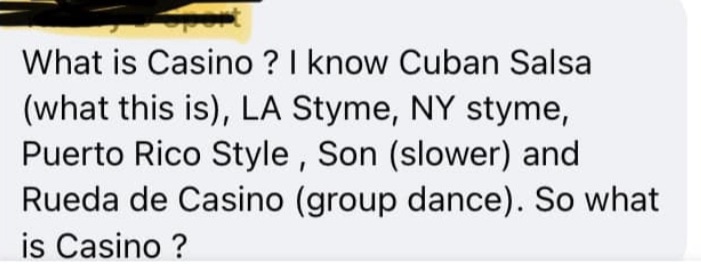
This person has been failed by every Cuban dance teacher they have ever had. At every step of the way, no one contextualized rueda de casino enough within its culture to explain that rueda de casino literally means “casino wheel”, a formation in which the dance of casino is danced. And most importantly: that rueda is not a dance.

This other person, who attends a weekly rueda de casino group, does not think that there are casino teachers where they live. What are they dancing in the rueda, then?
It’s not this person’s fault to be confused. The group they attend has successfully misinformed them because informing about the culture was not the goal; creating community was. And now this person thinks that rueda is a dance separate from casino. This is also another example of why good intentions are not good enough when choosing to create a Cuban dance group. You have to know your stuff.
In conclusion, precisely because of the disconnect between culture and product (see reason #2), many rueda groups (I call them “rueda groups” and not “rueda de casino groups” on purpose) are not anchored in Cuban culture. Not really, anyway. That is not a concern.
And so, when we talk about these problematic aspects of how ruedas are used, ironically, to misinform about and disconnect people from Cuban culture, people might feel like their community–and by extent, the joy and well-being that they have extracted from being in community–is under attack.
Hence why these discussions are difficult to even bring up.
Towards a way of fixing the problem
So how do we have honest conversations about the state of Cuban dance culture abroad without people getting offended?
Well, we can provide solutions beyond critiquing what is happening, which is what I am about to do.
But before that even starts, people have to be willing to accept that these issues might exist in their communities–and that they might be part of the problem.
For instance, some people who are part of the problem (consciously or not), might not even click on the link simply because of the title. They don’t want to deal with all this. Others might not make it past the first section where I talk about the problematic beginnings of Cuban dance groups. It is simply too uncomfortable.
And yet others might still be reading even though they might be feeling pretty vulnerable right now.
That might be you–and I think you’re likely a leader in your Cuban dance community if you have read this far (people who just dance don’t necessarily care about these nuances; they just want to dance). Whichever the case, thank you for making it this far. Thank you for your vulnerability. And most importantly, thank you for holding yourself accountable.
If you have made it this far, you have realized that there are issues in the Cuban dance community that need to be addressed, issues that you, as a leader in your dance community, can actually do something about. And while the issues are systemic, it is people who perpetuate and recycle the practices that uphold the system. We cannot have a serious conversation about this if we do not actively think about the ways in which we can be part of a bigger, systemic problem.
At any rate, here is how we begin to fix things:
Inform yourself about Cuban culture by being in community with Cubans.
That’s it! It is actually that simple.
A lot of what is happening right now with Cuban culture abroad happens precisely because capitalism and us, the people who uphold this system, have normalized the separation of the dance from its culture and its people.
It stands to reason, then, that we need to do the opposite in order to fix the issue.
If most people who promote Cuban dance culture abroad were in community with Cubans, I’d argue none of these issues would surface.
Let me explain.
If people who promote Cuban dance culture abroad were in community with Cubans, people would not think lightly about beginning a Cuban dance group in their town or city. In fact, people would think twice about doing this because they have Cubans who will hold them accountable. If you are an outsider to a culture representing that culture in public spaces, you should feel a certain “pressure” to do things right, to represent that culture in the best way possible. When no one is holding people accountable, they can do whatever they want, that they can get away with not knowing how to do certain things or what certain things mean–which is why we have these problems.
If people who promote Cuban dance culture abroad were in community with Cubans, they would know basic aspects of Cuban culture. They would know that “rueda” is not a dance, for instance. But beyond basic facts that can be found online, people would know about the diverse experiences of Cubans, their hopes, aspirations, and dreams; their conflicting ideologies and ways of thinking; their idiosyncrasies. In essence, people would see the full spectrum of their humanity. In the same way that it is hard to kill a pig if you have made it into a pet, or to eliminate an enemy of war you have gotten to know, it would be hard for people to think of casino as “just a dance” to be consumed and enjoyed (like I would a lamb korma in an Indian restaurant).14
If people who promote Cuban dance culture abroad were in community with Cubans, they would not only create “rueda” groups to foster a sense of community and belonging where they live; they would create rueda de casino groups that actively sought to include Cubans as an integral part of that community (it’s their culture, after all). Indeed, it would be unthinkable to create a rueda de casino group without the input and presence of the Cubans with whom you are already in community. (This goes back to the idea of “feeling the pressure” to do things right.)
* * *
With all of this said, some might be asking, what does it mean to be in community with Cubans?
I tried asking this question on the blog’s Facebook page and received four answers (out of the 8,000 followers I currently have). This suggested to me that not a lot of people are thinking about this–which is, again, the issue. Of the four people who responded, three said: taking classes from a Cuban teacher, or staying in communication with them if they still live in Cuba, or doing research online due to the lack of Cubans in their community. A fourth person said they stayed in community with Cubans by keeping a rum bottle at home. (I have to hope this person was joking, but even as a joke the comment underscores the capitalist nature of our interaction with Cuban culture).
A good starting point to start thinking about what it means to be in community with Cubans is these two interviews I conducted recently, one with Adrián Valvidia, the artistic director of DC Casineros, and the other with Nicole Goldin, one of the co-founders of Dile Que NOLA. Both of these groups are doing amazing work in terms of including Cubans in their projects–precisely because they have always been in community with them.
Interview with Adrián Valvidia.
The Cuban dance community abroad needs more people like Adrian and Nicole, more groups like DC Casineros and Dile que NOLA.
And if you made it all the way through the end of this article: the Cuban dance community definitively needs more people like you.
Notes:
- Click here for a list of concrete steps on how to be an ally. ↩︎
- For a more nuanced exposition of this issue, read this blog post. ↩︎
- For a more nuanced take on how even good intentions can uphold discriminatory practices, read this article. ↩︎
- In Latin America, this was done mainly through the system of encomiendas. As Chang-Uk Byun describes in this article, “In the New World, the Spanish colonists (encomenderos) held Indians in a socio-economic community (encomienda), and provided for them materially and, in cooperation with appointed religious priests (doctrineros), spiritually. The Indians were obliged to work, and the system was shortly to be denounced as slavery” (161-262). ↩︎
- This blog post explains precisely that in the context of kizomba: “For a more concrete example, I’ve seen a European instructor who has traveled over 60 countries (including Australia) teaching everything from kizomba to urban kiz (according to himself) –yet he has somehow not found time to visit Angola.” ↩︎
- As a way of an example, this article documents how Target stores removed Pride merchandise after backlash from customers. In another analogous incident, Bud Light turned a blind eye to the plight of transgender influencer, Dylan Mulvaney, who received death threats for promoting the Bud Light brand. ↩︎
- Other people have raised the issue that using “casino” in ads gets the ad taken down because the algorithm sees it as promoting gambling. That’s valid, but that’s not an excuse. Use the phrase “Cuban dance classes.” Problem solved. (Unless that person is not teaching something authentically Cuban, in which case calling these classes “Cuban” creates another problem.) ↩︎
- This helps us understand how kizomba, a dance from Angola, has entered the Latin dance scene. It’s simply what is selling. ↩︎
- More about how timba is not a dance on this article. ↩︎
- I am also ashamed to admit that I only learned about the complex history between Pakistan and India incidentally from watching, of all shows, Ms. Marvel. ↩︎
- Of course, there are exceptions to this. Many minority communities and communities of people of color within an individual-driven society do not subscribe to the idea of individualism and actively practice collectivism. Indeed, there is clearly a stronger sense of the collective within these communities. Nevertheless, individualism is the status quo in most Western cultures. ↩︎
- In 2023, the United States broke its own record for the most suicides in a year. ↩︎
- See report, “Our Epidemic of Loneliness and Isolation” ↩︎
- To give closure to this analogy, clearly, I am not opposed to enjoying a cultural product decontextualized from its culture. It’s not ideal, but I myself do it. That said, I am aware that this is precisely what I am doing. What’s more: it would never cross my mind to open an Indian restaurant just because I like this particular dish. ↩︎
Bibliography
Byun, Chang-Uk. “The Valladolid Debate between Las Casas and Sepúlveda of 1550 on the Conquest and the Intellectual-Religious Capacity of American Indians.” Korea Presbyterian Journal of Theology, vol. 42, 2011, pp. 257-276. Print.
McMains, Juliet E. Glamour Addiction: Inside the American Ballroom Dance Industry. Middletown, Conn.: Wesleyan University Press, 2006. Print.
Yancy, George. “Dear White America.” The New York Times Opinionator, 24 Dec. 2015, https://archive.nytimes.com/opinionator.blogs.nytimes.com/2015/12/24/dear-white-america/?smid=tw-share.
 Son y Casino