Some things get lost in translation.
Take, for example, the Spanish expression Te amo. While it can be translated to “I love you,” it does not really encompass the magnitude of the love a person is expressing. Spanish has two forms of saying “I love you”–te quiero and te amo. The former is used regularly among friends and family to express love and affection. But the latter… the latter is an expression that is often reserved for special occasions. It takes something out of you to say to someone Te amo. Consequently, when someone says, Te amo, it is not to be taken lightly. Te amo is serious, has unknown depths, and is a gut punch if you are not expecting it. As such, an “I love you” doesn’t even come close to encompassing all the nuances found in a Te amo. It pales in comparison.
When it comes to the dance of casino, I have found that there is a word that similarly gets lost in translation. Well, not in a language translation, per se–casino turn patterns rarely have non-Spanish names–but rather in dance translation. That is, translating to dancing what the word is meant to represent. For instance, it makes sense that a move called Sombrero–or “hat”– is done the way it is. The way in which the arms end in said move mimic putting on a hat. Likewise, for the move Vacila/la–Spanish for “check it/her out”–the follower walks and pivots in front of the leader as the leader–if we are to translate it to dancing correctly–visually assesses their dance partner…and sexism scores yet another point. But barring decades-old terminology that perhaps we should be questioning, these can be considered good “dance translations.”
Which brings us to Guapea. Which is not.
And oh, boy, is it not.
Guapea is the command form of guapear. The verb guapear, specifically in the Cuban slang, is loosely translated to “acting with arrogance or swagger”. Other parts of speech involving this word provide analogous meanings. The noun guapo in Cuban slang refers to a man who is not afraid to pick a fight. It’s an attitude, a way of carrying oneself. Some may call it “cockiness”. Another noun, guapería, in Cuba is used to refer to a state of showing off in a cocky or confrontational way (ironically, often faked). If someone is talking to you with guapería, they are looking for a fight–or they are really good at faking that they can kick your ass…or they actually can. You never know, that’s the point.
So, when someone says Guapea, they are literally telling you to act cocky, with arrogance, to add swag to what you are doing.
And that…that gets so lost in translation outside of Cuba.
Now that you are more familiar with Cuban slang, please do watch the following video and tell me if any part of this makes you think of guapería, or the act of guapear, or a a guapo.
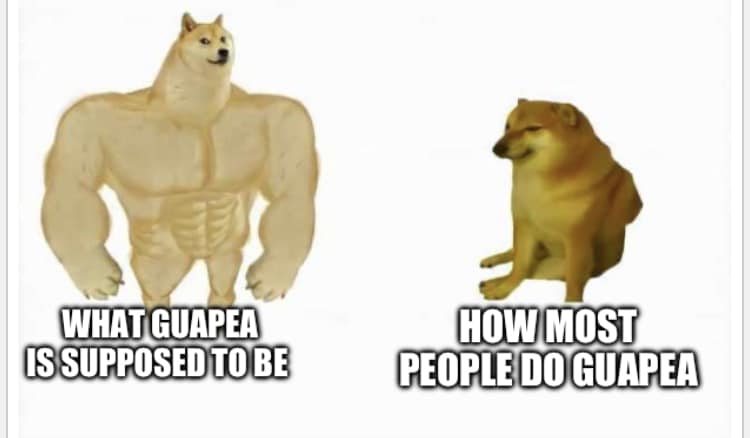
Personally, watching this video, it feels like someone said out loud ¡Guapea! and everybody else heard, “Be nice!” It’s too “pretty”, too bland. The word does not translate to what is happening in the dancing at all.
Also, this meme comes to mind:

So what does Guapea actually look like?
I am glad you asked. Here is a series of short clips where you can see a “good translation” of Guapea in action.
(I could never unsee that “butt Guapea“. Now, neither can you.)
You can clearly see that the people there are showing off, moving with swag, arrogance, guapería. These are examples of Guapea that have been translated correctly to the dance floor. (1)
Now, I did not make you read all of this so that I could tell you what Guapea actually means and how to translate it more faithfully on the dance floor. I did that already on the blog’s Facebook page in less than 30 words, and with the meme I used above. Indeed, an entire blog post about Guapea seems unnecessary–and a colossal waste of your and my time– if that is all it aims to do.
Instead, what I want to do with this post is to invite you to rethink what you call Guapea in the context of 1) rueda de casino and 2) the music to which we dance. That does need more elaboration, with a lot more nuance.
So, here we are.
Guapea: the problem with its overuse in the rueda
What you call Guapea is arguably the move that is most prevalent in a rueda de casino. It is so omnipresent that it does not even get called! People automatically do it in the rueda while they wait for the cantante to call out the next move. Other than that, at least in the way that it is used in most classes and while dancing socially, it serves absolutely no other purpose. Indeed, it’s just a placeholder until the next move comes along.
One could argue that an experienced cantante would almost never make use of what you call Guapea. Rather, he/she would constantly be calling out moves so that there is always something happening. Personally, if I’m ever the cantante, I usually call a form of Dame until I can think of something else to call. In other words, what you call Guapea can arguably be done away with in a rueda, and you can clearly see that this is the case in this 11-minute long video showcasing a rueda de casino competition dancing in Cuba. As you watch it, notice how the cantante calls the next move before the current one ends. He does not wait for the move to end–and thus for what you call Guapea to begin.
Similarly, in casino partner dancing, what you call Guapea is almost nonexistent. In Cuba, it is rare to see a couple doing what you call Guapea for more than 2 counts of eight, if at all. And when done, it often looks like the examples you watched above, where the move is used as a way to show off, not for the leader to think of the next move. Good casino dancing is fluid, one thing seamlessly coming after another. What you call Guapea stifles that. It’s like putting a dam on a river.
I will grant that what you call Guapea does seem to serve a pedagogical necessity. Most casino dance classes outside of Cuba are taught in a rueda format– to which I am strongly opposed, but that is a conversation for another post. For beginners who are just starting to grapple with new dance concepts, what you call Guapea provides a respite from all the moves that are being thrown at them. If the caller is not very experienced, it is also a breather for that person while he/she thinks of the next thing to call.
What ends up happening here is that the people who are learning casino in this formation–which, again, I do not recommend–internalize that the way they dance in a rueda is the same way they dance outside of it. So, when a move ends, what you call Guapea begins. Eventually another move begins, then back to what you call Guapea. And so forth until the song ends. In a rueda, it makes some sense: what you call Guapea is used to wait for the next move to be called. Outside of it, what or whom are they waiting for?!
Briefly redefining Guapea
At this point, repeatedly reading the expression “what you call Guapea” might have become annoying. That has been the intention, but also to drive this very point home: you are likely not doing Guapea. I say “likely” because it might be the case that you are translating Guapea faithfully on the dance floor. You are adding swag, arrogance, boastfulness, etc. But in the likely case that you are not (because this move was taught to you as a way to wait for the next call from the cantante, and that was it), that is all you’re doing: calling it that–probably, if I may add, without really knowing what it actually means.
Now that you know what it means, and now that you have realized that you are not translating Guapea onto the dance floor, what then?
Well, there are two options.
- You begin doing Guapea as what it actually is.
- You continue doing what you are doing–but call it something else.
I will delve into option A more in depth in the next section. But if option A does not speak to you at all, I’ve got good news. Option B already exists! Indeed, the not-Guapea that you do already has a name: Pa’ ti, pa mí (For you, for me)–also known as Abre y cierra (“Open and close”). That is the name that this move received in the 50s, when the dance of casino was first developed. Now, where does Guapea come from? I wish I knew. All I can tell you is what it literally means, and that you are likely not doing that.
Pa’ti, pa’mí
Abre y cierra.
These are the names of what you are likely actually doing. Start using these instead!
Centering Guapea in the music
Guapea, with all the swag and arrogance with which it comes, does have its place in the dance of casino. What I want to suggest here is that Guapea can fit perfectly well in certain sections of the music to which we dance casino.
You likely already know the sections. Perhaps not by name, but most certainly by feel.
In fact, if you have ever done Despelote, you have most certainly felt these sections.
In musical terms, these sections are known as the presión, masacote, and bomba.
Now, I am not going to get into very technical details about what separates one from the other. If you want to do that for yourself, this three-part video is a great resource, even if it is in Spanish. It has plenty of examples that you can follow along.
As a dancer, what you need to know is that these three sections in modern Cuban dance music serve to create either tension (presión, masacote) or become the climax of the song, where the instruments reach their maximum intensity (bomba).
And just like Despelote, Guapea–now that you know what it actually means–fits any of these three sections.
Here, let me give you some examples so that you can tell for yourself.
“Qué sería de mí” by Klimax has a presión section from 2:00-2:19 and a masacote section from 3:00-3:19. Do you need to know the difference between the two? Again, no. What you need to do is feel the difference between the masacote and the presión, and what comes before them in the song. Listen to the song, see if you feel the change.
Very clear change in instrumentation, right? It makes you want to stop doing turn patterns and let loose, doesn’t it? Well, I’d argue that that is the perfect moment for guapería!
Here is an example of a bomba section, from 4:20-4:29, from “Papá Changó” by NG la Banda.
Again, the change in instrumentation is asking for something else from us, the dancers. You can do Despelote here, of course. But hey, maybe you also want to bring out the swag.
As a parting gesture, I want to leave you with some dance examples, from yours truly. For years, I have been playing around with the Guapea during these sections. Besides the Despelote, that was what felt right to me. As I learned more about the music to which I danced, it only made explicit what I had felt instinctively.
Starting at 2:50
Starting at 3:24
Notes:
(1)If the people who are showing guapería are mostly the men, that is not by accident. The female equivalent of a guapo–that would be guapa– is almost unheard of. It does not become a lady to act with guapería. She can show off, but not in that way. It’s simply unladylike. (If this way of thinking bothers you, just like with Vacila, perhaps we should be questioning some of the terminology that we take for granted.)
 Son y Casino
What about Casino classes where Guapea is used as a “holding pattern” (AKA “basic step”) while everyone waits/gets synchronized with the instructor?
In other words: is there a “basic step” or “holding pattern” in Casino? … or is that just a teacher aid that isn’t used in Cuba?
Asking because in e.g. Kizomba the “basic steps” that have been used in Europe for a decade look dubious when checking with Angolans, or even when comparing videos of European and Angolan dancers and parties.