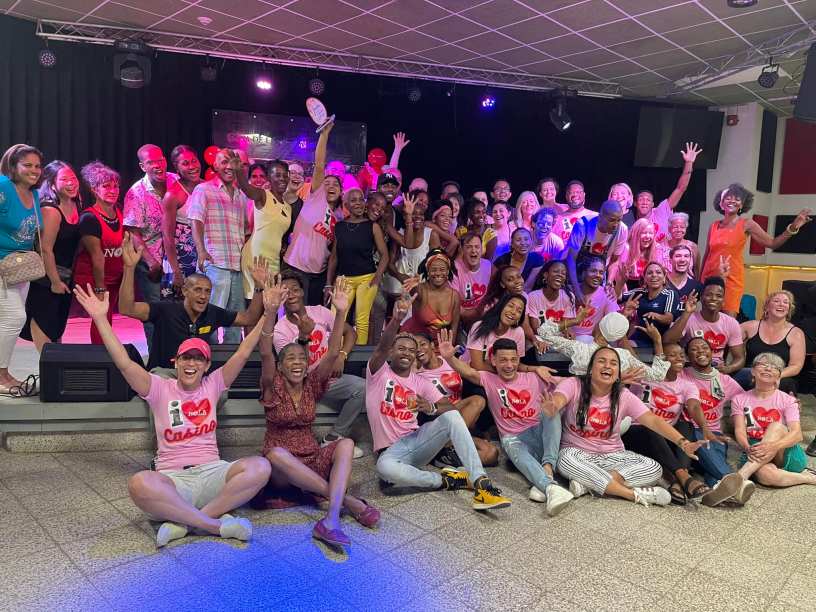
Nicole is one of the co-founders of Dile que NOLA, a non-profit organization focused on the promotion and dissemination of Cuban dances, based in New Orleans (United States). I believe I’m not mistaken in saying that their organization’s Facebook page is one of the most attractive to Cuban audiences, both within and outside the island. Just by taking a look at any video they post on the page on quickly notices that there is a significant Cuban presence in that space. For me, when Cubans organically come to your page and validate what you’re doing, you’re doing things right.
And that speaks volumes about the work this organization does, about Nicole’s and all the other members of Dile Que NOLA’s commitment to Cuban culture and its people. About their intention to showcase casino beyond consumerism and enjoyment.
As a Peruvian, Nicole will always support Cuban culture. The Cubans themselves. That’s one of the things that makes her exceptional.
So I couldn’t overlook interviewing her so everyone could see what I see: a mambisa of casino, a guerrilla fighter for Cuban culture.
But above all: a wonderful human being.
DL: Tell me a little about how you all started.
NG: Dile Que NOLA began as a group of women who banded together. We were taking classes at another school, called Bookoo Rueda. Over time, we realized there were few leaders (males, men) and one of the female members was kind of pushing us women to the side. We started to unite. We didn’t even know each other. It was something like: “Hey, I like how you dance. Would you like to join our ‘clandestine’ practices?” [Laughs] That’s how we started.
We were eight girls. Then we became ten, and when we reached that number during a Memorial Day weekend, we decided we were going to stage a “coup,” that we were going to “come out of the closet” as casineros at that party in May 2015. That’s how it was created, and then it remained a point of pride for us that we were women leading and taking turns leading. Later, we realized there were many men who were showing interest in participating in our practices, which were free, community-based. That’s how we grew, and we let the men join.
In that same year, one of our founders, who was a lawyer, suggested that we become a non-profit organization to apply for grants and things like that—something we never did—but it was a good thing to have.
It all really started from being curious about how to make a rueda de casino exist and learning to call it and understand it—all the things that were so interesting about how it worked. I remember we would call an “Enchufla al centro” and when it didn’t work, we would try to understand why. It was the best.
DL: So, that’s how Dile Que NOLA started, as a sort of offshoot from another group. But, how did Nicole Goldin start to become interested in casino?
NG: When I was seventeen, I got into rueda de casino because I fell in love with a boy. One day, that boy suggested we take “Cuban salsa” classes. Now, if I’m going to be honest with you, I wouldn’t even say what we danced what we have agreed currently constitutes Cuban salsa. It was more like a mix with cumbia—a cumbia with salsa. It actually resembles casino more than Cuban salsa.
I had never seen a dance in a circle where people changed partners. To me, it was like getting on a roller coaster. And from the first class I took, I was fascinated because even though I went to learn to dance with a partner, simultaneously, there were people on that “roller coaster,” and I kept thinking, “I want to get on that.”
I am a musician. For me, this was also a challenge to understand how my body synchronized with the music—music I had listened to for as long as I can remember. I don’t know if you know, but Lima, Peru is the capital of timba.1 That means I had heard it all my life. And now I knew how to dance to this music. That’s how the bug got into me, back in Lima.
When I moved here to New Orleans, I lost something that was so important to me. It represented my community: the times we would go out dancing on weekends, get together every weekend to practice rueda de casino. It was something super healthy and important in my life. And I lost it when I came to the United States.
DL: What I’ve noticed, when I listen to the reasons people give when they talk about how they got into casino, is that a genuine interest in Cuban culture is not part of those reasons. Generally speaking, it’s because they wanted to be part of a community, because their boyfriend was there, because they were looking for ways to make friends—and this was what there was.
And that’s fine. I don’t have a problem with that because I myself go to a Peruvian restaurant to eat ceviche and drink a pisco sour—and that’s it. Beyond that, and the things I’ve seen, I don’t know anything else about Perú. The experience I’m having with Perú, in that context, is a very capitalist experience in the sense that the system is very good at divorcing the culture from the cultural product. I can go eat Peruvian food without having to know anything about Perú. The same happens with casino. One can join a rueda without even knowing it’s part of a Cuban dance.
NG: I didn’t even know why it was called “rueda de casino.” It was in the U.S. that I understood. I imagined it was danced in a gambling casino, and that’s why they called it that. It wasn’t until I started looking for a place to dance that I understood that casino was the dance itself.
DL: That’s what I’m saying.
Casino (or rueda de casino) classes are often given like this: “Today we’re going to learn Balsero.” And you learn Balsero, and that’s it. There’s nothing more. It’s something completely divorced from the culture. It’s just the turn pattern, the movement. And that’s it.2 And again, that’s fine if you’re getting into the dance. But when you’re going to teach or show things publicly, then you have to be a little more rigorous because you are showing a culture. And if you don’t know what you’re doing, how much can you say you’re representing Cuban culture with fidelity?
At any rate, tell me a little about Dile Que NOLA’s mission at the beginning. When you started, what was the group’s goal? Did that goal change over time?
NG: Definitely. At the beginning, it was to create a safe space for women to practice and become self-sufficient in dance. Then, the goal transformed into growing the rueda de casino as much as possible and being super, mega inclusive, so that anyone could join our rueda. (At that time, we were in the stage of “if you know these figures, you’re a good dancer.” So back then, we focused a lot on learning figures so that people felt they could dance.)3
Later, the mission transformed into trying to, through our dance, maintain the group’s spirit of inclusivity while also trying to disseminate Cuban culture in New Orleans. Not only through the casino figures but also by talking about Cuban culture. We started doing this because we began traveling to Cuba and learning about Cuban culture; we also began talking about the similarities between Cuba and New Orleans and how the cultures are quite similar.
DL: What I infer, then, is that the mission of Dile Que NOLA transformed as you got more in touch with Cuban culture and got to know more Cubans. I know one of the group’s founders, Abril, and I know she’s Cuban. Was she the only one?
NG: No. There were her and her cousin Angelica, and Angelica’s sister, Elizabeth. They were born here. Rachel, our president, her mom was a first-generation Cuban. And another member, Yasenia—she was born in Cuba. So, there were five Cubans out of the ten women we were.
DL: That’s the other thing I always like to highlight. Things don’t happen by coincidence. The way I see it, the transformation of Dile Que NOLA’s goal happened precisely because there was a connection to the Cuban community from the beginning: the founders of the group, consciously or not, pushed the others to learn more about the culture. I imagine that created a kind of “pressure”: 50% of the group is Cuban, this is a Cuban dance, and therefore we should do our best to represent the culture. When did the group’s objective change precisely to this?
NG: I would say in 2016, a year later. We had already made our first trip to Cuba, and things started to get a bit more serious. We felt a level of responsibility.
I won’t lie to you. Sometimes, out of ignorance, I made many mistakes, saying things like: “This word means this in Cuba” and I was wrong because I was thinking of what the word meant in Perú, not realizing that in Cuba the same word had a different meaning. I had to understand what “Vacílala” meant, for example, because in Perú and Cuba, they are two completely different things. So, after having to eat my words two or three times, I said: “Hold on. I can’t make a fool of myself. Supposedly, I’m representing Cuban culture. I have to immerse myself in it.”
DL: Exactly. And that awareness unfortunately doesn’t happen much with others because there isn’t that connection with Cubans. In your case, there was no way to not connect: 50% of the group was Cuban. If you made a mistake, someone would say: “Hey, that doesn’t mean that in Cuba.” But imagine someone who starts a casino group without anyone who is Cuban or knows Cuban culture well enough to hold you accountable.
Let’s go to another question. I know Dile Que NOLA is a non-profit organization. Tell me what having this status has allowed you to do.
NG: What it has mostly allowed us to do, beyond the practicality of the status itself, is that having it has helped us organize and take things a bit more seriously. When we commit to something, we do it. It forces us to maintain a super friendly and inclusive posture because we are a community-based organization. So, there is no room in Dile Que NOLA for gossip, drama, cliques—things that happen a lot in dance communities. So, first: the need for organization; relationships and drama come second.
It also helps with credibility and gives us the ability to access certain resources or opportunities we otherwise would not. For example, using certain spaces at reduced prices or completely free to do our projects. Or being invited by the Jazz Museum to do a presentation, etc.
Being a non-profit organization allows us to live the vision we have.
DL: This is something you share with DC Casineros, who are also a non-profit organization. And I’m hearing the same thing from both of you. I believe that to do this well, without having to worry about the market and income, you have to do something like what you are doing. Because in the end, when your aim is to make money, things get murky. So, I’d like to ask you: how would Dile Que NOLA be different if it were a dance academy with all the concerns of a dance academy that relies on this to survive?
NG: Let’s start from the beginning. Currently, Dile Que NOLA doesn’t have a teacher. There isn’t that dynamic of teacher and student. I know I’m the one who leads the practices, calls the wheels, and teaches, but I don’t call myself a “teacher” or “instructor” because I feel that doing so gives me even more responsibility. I also feel that as Nicole, I have the freedom to decide if I want to sacrifice my Mondays, if I’m willing, and if I want to give the practices on Monday for my community, not out of obligation. That’s also important: for me, Dile Que NOLA is not an obligation; it’s a pleasure.
When the group becomes an obligation and a way for me to earn a living, the group will lose its essence. The fact that none of us organizers receive money from Dile Que NOLA means our intention is purely community-based. We live privileged lives. We work and are professionals. Therefore, we can do it. But if the group were led by a Cuban instructor or teacher from ISA, living in New Orleans…how great that would be, but I know it would definitely be more like a dance academy where you have to pay to attend, train, and there would be certain obligations, not just for the teacher but also for the student.
Many of our participants tell us that they love the freedom of knowing that even if they go to Alaska for a month, there will always be a place for them in the group, no matter how long they’ve been absent. It’s like a big family. We don’t close the doors to anyone for not attending, not paying, or whatever.
DL: Speaking of community, what is the most difficult conversation to have with other people?
NG: Currently, the hardest conversation for me to have, not locally, but with casineros in the U.S., is the conversation about what organic, empirical casino is—the one that was born in Cuba, which we want to preserve. Over time, I’ve noticed that when you try to talk about that, you’re labeled as a “purist,” or they associate you with certain people I don’t even know. They put you in a box.
This is a challenge for me. It doesn’t happen in my community because here we try to return to the cultural context of where all this came from. Dile Que NOLA has been blessed with the presence of my wife, Wilma, and other Cubans in our community, who are worthy examples of how casino is danced, without having learned it in schools or with a specific method. Instead, it’s the method of “let’s learn it like in the ‘beca’” (over there in Cuba).4
So, on social media, I feel it’s sometimes difficult to talk about these topics because maybe they (the people from other communities who follow us) don’t have a Wilma to see that. They only have the gossip from social media about purists versus non-purists, salsa versus casino. And in the end, the choreographic version that casino has had since its creation gets lost, and that’s precisely what we want to maintain: that choreographic version that lives in the Cubans here in our community. So, we put them, our New Orleans Cubans, on a pedestal and say: “This is how we want to dance. We don’t want to dance for a show. We want to dance like them, the way they dance at parties, in the park, when we go out on weekends. That’s how we want to dance. Nothing more.”
DL: Definitely, that conversation is quite difficult to have. Well, you know I left Facebook for a month precisely because when I tried to raise awareness about this, a lot of people came to my page every day to attack me. But yes, going back to what we were talking about earlier, it comes back to having Cubans in the group helping a lot—people like Wilma, who learned casino empirically and without an academy.
(I am very different; I learned it more formally with MCC, and before that with Salsa Lovers. I had a completely different path, so I can’t say I dance like Wilma, nor she like me. But at the core, we are both dancing casino. That also needs to be nuanced.)
Having Cubans in the group or being surrounded by Cubans, even if they’re not in the group; having Cuban friends who see you dancing and say: “Hey, that’s not how you do it”; or dancing with them and noticing certain things because you’re dancing with them—all that is very important. And many groups don’t have a Wilma or Cubans in their community who can be that point of reference.
So, the question I have is: Why do you think people feel the need to start a casino wheel group without knowing much about Cuban culture or without even knowing Cubans? What’s going through the mind of someone who is not surrounded by Cubans, who doesn’t have Cuban friends or a Cuban partner, who doesn’t speak Spanish, who has never been to Cuba, who has been to three small congresses, and suddenly says: “You know what? I’m going to open my school”?
NG: I think we need to acknowledge a reality. For many people, dance is just dance. It’s fun. It’s an escape from a busy life. It’s the moment where they can enjoy themselves, exercise.
For me, culture wasn’t always at the center. Culture came to me when I started exploring things more. So, I was privileged in that sense. If culture hadn’t come to me, I probably could have spent many years saying: “Look, you know what? I think I dance pretty well. Many people tell me so. I like that other people dance. There aren’t many people who dance in this city. So, I’m going to create my little school so they can come dance with me because in the end, what I want is people to dance with.”
It’s like, out of ignorance, or simply wanting to create a space for yourself. Or it could also be an ego thing (“I feel good; I want to be the star, teacher,” whatever). I think there can be many reasons, but definitely, I can’t lie and say culture came first. Culture came later, and that’s why we’re here after nine years. That’s my hypothesis.
DL: I reiterate: I have no problem with people being interested in casino simply because they like how it looks. To continue with culinary parallels: I go to a Colombian restaurant and what I want is a bandeja paisa. But for me, there is a difference between having an interest and publicly showing something as “Cuban.”
So, yes: the reason why a person starts can simply be out of curiosity. That said, does that reason have to change at some point if that person has a school or group, or is thinking about creating one, or is doing public performances? We’re not talking about a “Let’s meet at your house.” We are talking about people who are publicly presenting and saying “This is rueda de casino, and this is from Cuba.” Does the reason have to change?
NG: Yes, it has to change because, as we have talked about before, unlike many other dances that are not representative of a culture, casino is exactly that. Casino represents Cuban culture. For example, I did folk dances in Perú. It’s as if someone created a marinera academy here and that person had no idea where marinera is danced or that there is a difference between northern marinera and limeña marinera. Perhaps this person learned marinera out of curiosity because they saw it in a YouTube video, but eventually, if you are going to create an academy, a school, a community—whatever—you have to know what you are doing. Even if you are not the best instructor of the steps, in terms of culture, I think it is our obligation to understand, educate ourselves, and try to get as close to the culture as possible.5
DL: I like what you just said because it is precisely the way that many people should think about it. That is, asking themselves: if someone who is not from my culture approaches one of my folk dances, what expectation would I have for that person? Because you should have that same expectation for yourself when you get involved with the dances of a culture different from yours.
I’ve had several people send me messages asking me to help them with this or that part of a class they are teaching…but they are teaching. They don’t understand something they need to know to teach…and they are still teaching, creating an incomplete idea of my culture. The standard is not very high. Anyone can open a class. As a Cuban, I feel that a lot. Many times there is no rigor and the personal purpose of approaching the dance replaces the cultural commitment.
Moreover, if you go beyond the personal, for many, it is more important for the community to have cohesion than to do something that authentically reflects the culture. That’s why I asked you the question about the most difficult topic to talk about: because what is happening (from my point of view) is that a community of Cuban dances has been created under the precept of “community,” of inclusivity—which is not bad. But by doing this and only focusing on the community and friendships—forgetting, therefore, about Cuban culture—when someone comes and tells you: “Hey, wait a minute, don’t forget about my culture. This is not done this way in Cuba,” what that person is doing is breaking the bubble a little. And then that Cuban who is trying to reorient people gets rejected for being “difficult” and relegated to the periphery of their own culture, while others, who are not from that culture, enjoy it without any stigma.
There are many people who say they do something Cuban, but if we look closely and look at what is being done in Cuba, we see that they do not get very close to the culture, that there is no understanding. And I think that’s why there is that tension that comes from normalizing the attempt at community without necessarily understanding the culture that is giving us this space to create community. And when someone from that culture comes and says: “Wait a minute. There is also a culture here,” that discussion is created.
You mentioned earlier: the most difficult conversation for you happens when you try, outside of your community, to teach concrete examples of how Cubans dance—and people come with other ideas. I would say this happens precisely because it has been normalized to teach a dance without a cultural context, without really understanding where the dance comes from. Dance has been taught as dance, completely divorced from its culture.
NG: And I will tell you something else. Dile Que NOLA has grown a lot on social media. We talk more about cultural things and, therefore, our followers find out, but for a long time, we only had one class a week from 7 to 8 on Mondays. So, what you really want to do when you only have one hour is to dance rueda de casino—and a bit of casino. There is not much space to talk about the culture. However, we have these Cuban people who share their culture with us and who, during the rueda de casino, are joking around, demonstrating their culture live and in person.
That’s why I just committed myself to creating a new series that started yesterday, called “Fundamentals of Casino,” which is a four-week series that repeats every month. And in those classes, we are putting culture and music at the center stage. Since yesterday, they have already been answering questions about assignments I gave them about the music (understanding the largo, the montuno,6 the mambo section7). The first assignment was the song “Llegó la música cubana.” I sent them to analyze the song, understand it, and of course, the video of Dáybert and Wilma as an example of how it should be danced: closed position and then when the montuno comes in, you can do more.8
So, we are trying to raise awareness so that new people join the community, but with a bit more context.
DL: Excellent.
Recently, you started uploading some videos where you go through the streets of Havana, talking to Cubans about the state of casino in Cuba and asking them to dance.
For me, seeing that… I almost cried because, first, someone is finally going to Cuba to talk to Cubans; and second, because I always wanted to do that project, but due to time and money, I couldn’t. And also because when I go to Cuba, I go to see my family. I can’t go to Havana to interview Cubans and leave my family in San José. Every time I go to Cuba, it’s to live like a Cuban, experiencing the blackouts, the needs. I’ve never stayed in a hotel.
NG: To be honest with you, the only reason I did this was because this was the only time I went to take my mother-in-law back to Cuba and had an extra night–and it wasn’t with Wilma. Because when Wilma is there, we are 100% with the family.
DL: Personally, I hope that other people, as you encouraged at the end of the video, continue this project because it’s fantastic. So, tell me a little about why you decided to do something like this?
NG: Many reasons. First, I feel it hadn’t been done. For me, it was the only way to debunk the idea that casino is no longer danced in Cuba. I saw on social media comments like, “You want to dance the casino of the dinosaurs,” and “the evolution of casino.” I understand that casino can have its evolutions. I don’t want to be regressive at all, but people do dance casino in Cuba. And not just people of my mother-in-law’s age, but also young people who have learned from people her age. All kinds of people dance casino. There are many people in Cuba who have no rhythm and don’t know how to dance. But those who know casino, dance the empirical casino I talk about. Nothing like line dancing, eighty turns. None of that. It’s a completely social and organic dance.
I didn’t want to get into the back-and-forth on social media. And I went with this mindset: I am a Peruvian who knows nothing about life. I am going to Cuba and I will ask the people of Cuba. Surely when I ask, they will tell me I’m crazy and reject me for being a foreigner.
But many people said yes and dared to dance casino with me. Casino is something so simple and everyday that it proves even more that it is alive in the Cuban land.
DL: Do you think there would have been a need to do this project if people were better informed about how casino is danced in Cuba?
NG: Maybe not a “need.” I think not. If people danced casino as it is, I don’t think I would have had that need. Also: there’s another part to it. It’s not just about the U.S. and how people dance it here. It’s also about our experience in trying to find dance schools–professionals in Cuba–to teach us to dance casino, the street, the home, what they learned in the becas. Those professional dancers–bailarines–9have a school dance standard. They can’t always take off the bailarín‘s hat and return to simple casino. As almost all my encounters with Cubans in Cuba dancing have been with bailarines, I wanted to see how people who are not bailarines dance. Because even when we go to clubs like 1830 to dance socially, there are the bailarines who teach us… and the rest are filled with professional dancers who go there for tourism. So, it creates a fictitious environment, beautiful and super fun, but fictitious. I always suspected that spaces like that and similar others were not endemic, natural.
DL: They were a kind of tourist trap.
NG: Exactly. That said, there are people who dance empirical casino in those places, but you have to know how to identify them. When you are a tourist going to learn about Cuban culture, those places create confusion. Even if you can find casino–let’s say one in five is dancing normal casino, without much fuss–I would say it’s hard to reach the capacity to identify that one in five. And if you’re a foreigner just learning about casino, the other four out of five create that confusion.
DL: Yes. You need a very robust structural understanding of casino to be able to do that.
Going back to your project, I loved that someone from outside came with the mindset you mentioned: pretending to know nothing and going to Cuba to see how people dance, and that if they are dancing casino with Obatalá or with guaguancó (as many from outside believe casino is danced), then that’s what is done in Cuba.
NG: Exactly.
DL: But that’s not what is done in Cuba, and you saw that by doing the project.
Well, I also recently saw that you went to Cuba again with another purpose: to train with the All Stars. Tell me more about this collaboration because you mentioned earlier how artists sometimes can’t take off the artist’s hat to teach a social dance. The All Stars people, however, are mostly not artists, but university students or young people with a trade. In other words, social dancers, bailadores. How was the process of working with people who approach empirical casino more closely when teaching, but have had enough contact with tourists to know what tourists like and don’t like?
NG: I was very honest with Jorge (the director) because I have had a very good relationship with him for years. I told him: “Look, my brother, this is what I want. I don’t want to tell you how to teach me, but I want to tell you that your team doesn’t have to teach me in a way to satisfy our needs. Bore us. Give me the basic class. Teach me the fundamentals. Don’t feel you have to teach me a spectacular combination or rueda formation. What I want is that when the classes are over, my people can dance casino in pairs without feeling like oddballs. And I would also like, if possible, that you teach casino with forward marking because that’s what I, with my own eyes, see that the bailadores–not bailarines–do.” He told me: “No problem. Let’s get to it and see what comes out of this.”
There were many things that were outside of our comfort zones. For me, it was asking a teacher to teach me and my group in a certain way. For Jorge, it might have been outside of his comfort zone to teach with the marking he doesn’t usually use because he usually teaches a tourist audience where the usual marking taught is backward or any direction that achieves the choreographic goal.
And finally, there was also a third component that I think was new for both Jorge and me. Jorge has a dance company and there are people from all kinds of backgrounds in it. Over the years, it seems that Jorge chooses who the “heads” are, those who are qualified to teach. Not all of his bailarines usually teach. I asked him that, out of the ten hours we were going to train with his company, half of them would not be in the usual format (each one with their partner and a leading couple teaching a figure, which everyone else repeats), but that I wanted five of those hours to be more personal: each person in the group dancing specifically with a Cuban, and that Cuban hammering and tearing apart the person for how they were (mis)interpreting the casino from their foreign perception–that is, “salsifying” the casino.
That was a challenge, outside of Jorge’s and all his bailarines‘ comfort zones because now everyone, regardless of their level of experience, had the responsibility to teach. And I, knowing my people, met with each of those bailarines and their assigned partners and said, “Look, she is ‘Lola.’ And ‘Lola’ is very heavy when dancing. She tends to mark backward.” And so personalized teaching was done for each person, with a lot of transparency. I personally told the teachers, “Destroy them.”
That was very new, and I think it’s also new in the world of Cuba travel for the purpose of learning to dance. And Jorge liked it. In the end, we had a meeting together. He said, “I liked that idea. I liked giving that kind of autonomy to the teachers.” And very interestingly, in my opinion: many of the teachers who were newer in the company danced the most genuine casino. They seemed to be less a bailarín and more of a bailador.
DL: Yes. It’s true that the newer you are in the world of teaching casino, the less exposure you’ve had to tourists and the less you’ve been “contaminated” by the “salsa” demands of tourists, the more genuine your casino will be. In fact, I would prefer to have that pedagogical dynamic you mentioned, completely with the new ones. Because it also gives tremendous agency to the Cuban to define their own dance, as they don’t have to adjust to what a foreigner asks, but that person has to adjust to how the Cuban says casino is danced. So, returning to your anecdote, yes: it makes sense that the newest teacher danced a more authentic casino, less contaminated with other things that come from constant exposure to the demands that tourists have when coming to Cuba–which, many times, are pure dance fantasies.
NG: Yes. And Jorge told me that he would like to replicate this with the next schools that come. And that the schools can also appreciate that. For someone who is learning, it’s not easy to appreciate receiving so much constructive feedback.
DL: Or as Adrian Valdivia call them it on another interview: “cultural slaps.”
NG: Yes. Highly recommended to work with them especially for those foreigners who are willing to have an open and humble mind.
DL: Well, I also saw that you closed that trip to Cuba on a high note: you celebrated the ninth anniversary of the founding of Dile Que NOLA in Havana. And what’s more: you created a space for ordinary Cubans–not just the instructors–to come and dance casino with the group. (This was another thing I had never seen done in Cuba). Tell me about why you decided to do this, and what the experience was like once you did it.
NG: As you mentioned, it was our ninth anniversary that month, and we wanted to celebrate, whether it was in New Orleans or anywhere else. But it just so happened that we had a trip already planned around those dates, and we said to ourselves, “What better than to celebrate it there?”
Now, there were many fears and concerns because we had never organized anything in Cuba. And organizing something formally, not on the sly, in Cuba can be a problem. The original idea was the same concept as our event “Timba at the Park” that we do here. That is, we take a speaker to the park and invite people to come and dance with us. But doing that in Cuba opened the door to problems with the sector chief, with the CDR, for them to come and say to me, “Who are you? Why are you organizing this here? You’re not from Cuba,” etc.
So what we decided was that the best way to maintain that original idea–to have a big gathering in a public place–was to rent a venue, which in the end, paid in dollars, is insignificant for us Americans because of our purchasing power. And so we could control the maximum number of people and also have a space with the capacity for speakers.
The one who helped us organize the trip, a dear friend of ours in Havana, had a contact at a place where her daughter is having her wedding party this year. And we said, “Well, if the original idea was to do this in an open-air park, let’s offer free entry here at this venue.” And it wasn’t just entry. We bought 36 thermos of beer, prepared a cake and some boxes with croquettes and other snacks. We also held a dance competition, with prizes.
We made a budget of what we had raised from the trip and agreed on how much money we were going to allocate for the party. Because in the end, what we wanted–the goal of that trip–was to give back to Cuba what we took from Cuba.
There were 100 people who signed up for this party. We had a list of everyone who had confirmed. Some people were so excited that they even sent their ID photo to confirm their registration. [Laughs]
All this took place in El Cerro, at the EGREM Music House, and although the place was beautiful, the location wasn’t the best. The place was nice, but there was no easy way to get to it using public transportation. Many people throughout the night would write to us and say they still hadn’t found a ride. We know, for next time, that we’re going to do it in a super central place, with easy access to public transport.
Another thing about the people who didn’t come–because it wasn’t the full 100, maybe around 70–was because (and this is what the Cubans who did come told me) maybe they didn’t come out of fear. That is, not being able to believe that something could be free, that maybe this was a scam.
An anecdote about this. There was a woman who came from Bejucal to the party. She traveled more than two hours to get there by public transportation. She told us that her family told her she was crazy, that she was going to be scammed, that it was dangerous because it was nighttime and the party ended late and she would have trouble getting back. At the party, she told Wilma that she told her family, “No. I’m going because I’ve been following Dile Que NOLA for years, and I trust them.”
People came, and they knew who we were. It was like a strange thing to feel like a kind of celebrity from social media. There were people who knew who I was, who Wilma was. And we also knew who some of them were. There was a lady who had been commenting on our videos for a long time, and I finally met her in person.
It was really an incredible encounter. The All Stars were still with us, and they themselves helped us with the animation. One of their professional dancers who does ballet and contemporary made a surprise presentation in gratitude to Dile Que NOLA. It was a super special night, and I, being the cheesy person I am, almost cried on stage. It was incredible to see how the American and the Cuban danced together and made like a little community for a moment. It felt so good. If I had to do this trip again, I would do the same.

We’re going to do it again next year. We took a lot of videos. So next time, when we announce it, we’ll use those videos so that Cuban people know that the event is real.
DL: What do you want people to take away from the event you just held in Cuba with the Cubans?
NG: It’s the same idea as the interview videos we started doing with people in Havana. With nothing we do do we want to be the pioneers or the only ones. If we can contribute ideas, we contribute them. We don’t want copyright, or any of that. (And maybe someone has already done this, and I don’t know. There are many groups that go to Cuba).
What we do believe is that this is necessary because casino is being lost because with so much inflation and life being so complicated in Cuba, people prioritize their basic needs before paying the entrance to a Casa de la Música. So if you have the economic possibility to help preserve casino in Cuba, why not do it?
Let’s be honest. When you organize a trip to Cuba, there’s always money involved. There’s always a profit for the organization or dance company that does it (of course: it’s a service provided). But from that profit, it won’t make much difference if you set aside a bit to hold a party or some kind of gathering with the people who created that thing you love so much. So: there’s money to do it, you don’t need more than a thousand dollars–which goes a long way in Cuba–to be able to hold a party in Cuba.
Another thing I’ve also noticed–and this comes from conversations I had with professional dancers in Cuba, with some friends from Seattle who were in Cuba at that time and went to our party, with ordinary people who went to the event–is how foreigners (people from Europe, for example) organize festivals, congresses in Cuba where they promote the Cuban bailarín–which is fine–but there’s no space for the bailador, and, moreover, nothing is given for free to the Cuban.
Last year we went to a festival in Cuba that we loved. We had a lot of fun. But there was a big problem, which I think was the inspiration for this party. We told the organizers that we were going and buying the “Full Pass”, but just as the ten of us were going, we wanted another ten Cubans to accompany us to the parties. The organizers told us there was no problem but that we would have to buy passes for the Cubans when we got to Cuba. So, we bought our 10 foreign passes in advance.
Well, when it came time to enter, the Cubans weren’t allowed into the venue or to buy passes. For me, that was unacceptable. And the excuse they gave me was that it wasn’t because they were Cubans, but because of capacity…
DL: No, it was because they were Cubans. Believe me, it was because of that.
NG: In the end, the consumerism we have of that Cuban dance that we love so much is gradually alienating the Cuban from their own culture and their own dance. And the only place where they can consume it is at home, or at a neighbor’s house, or at a friend’s house–not in a place where it used to be danced. They don’t have that opportunity anymore. So I think we can give it to them. I’m not saying we’re going to have a superhero complex now, or go “save” casino in Cuba. But we have our dollars, and we can contribute.
DL: Well, what you were describing of not allowing the Cubans to enter is precisely a ramification of what I was telling you earlier: we have learned to dissociate dance from culture, to the nefarious point as this–that we’re in Cuba, and the Cuban can’t go to their event. Outside of the bailarines–who are the ones holding up that system–the Cuban is dispensable. And another thing: the organizers of these events in Cuba are mostly not Cubans.
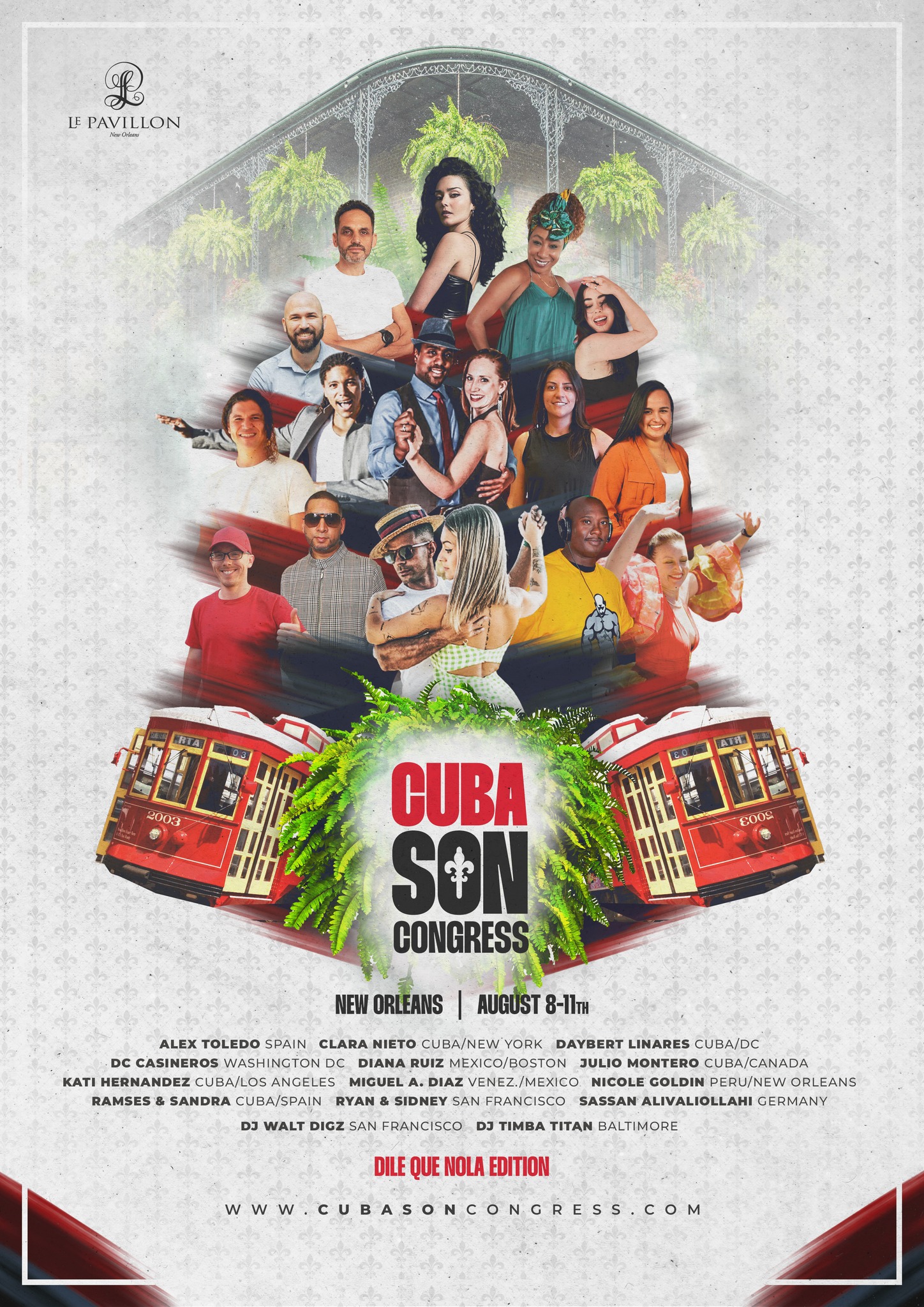
Speaking of events, let’s talk about Cubason.. The next installment of Cubason will be in New Orleans from August 8th to 11th, and Dile Que NOLA is co-organizing it. This is the first time Cubason is being presented in the United States. What did Dile Que NOLA see in Cubason and in its mission that made the group say, “Let’s do it here”?10
NG: I went to Cubason in 2023 because I had seen Ramsés dance and (knowing that he was bailador that went through a dance school) I loved how he danced. I said, “He has cracked this. How can he dance and teach in this way?”
We brought him to “Toda la Familia,” our festival (which is great, I love it). Ramsés loved New Orleans and had such a good time that he said to me, “I have this crazy idea. Let’s do this.”
Just before he proposed that, I had posted on social media asking if there was interest in organizing a festival that would move from place to place across the United States. And well, everything just came together at that moment to say, “Let’s do Cubason together.”
What I saw at Cubason last year in Mexico was something that really resonated with my belief that this was a space for the bailador. And it’s important to use that word because that’s how I define myself. I’m a bailadora, just like my wife, my mother-in-law, and the people I like to share with. In many of the congresses or festivals I’ve attended, I (as a bailadora) have gone to learn from a performer, which is an unattainable goal. I don’t want to become a bailarina. I want to be a bailadora and when another bailador dances with me, I want them to say, “What a great dance we had! What great casino we danced.”
So, I felt that it was a congress where the idea of the bailador and the important difference it has from a performer was being preserved. All of this was very similar to the idea of “casino cousins” that we had, of community. I believe that we, with our message of peace and love, have many things to contribute to Cubason (a unique corner for the bailador) and I feel that the marriage of the two is ideal. Furthermore, all the instructors had a similar level of teaching.
I think it will be the first of many incredible experiences in the United States with Cubason in general. I want a standard to be created here for what Cubason should be like from that moment on and for Cubason to also inspire other congresses and festivals to have all of this, preserving social dance for the bailador, but also with these things that are as important as the panels we are planning to have during the congress.
DL: What can someone expect from attending Cubason? Or in other words, what would an attendee take away once the event is over?
NG: When someone participates in Cubason this August, they will be able to understand the fundamental aspects of each of the Cuban social dances that we are offering. Not only the dance itself, but also its historical and cultural context. Apart from that, they will also leave challenged – not only in their skills as a bailador but challenged to think beyond what they are doing at the moment and understand how what we are doing today matters for the future generations of casino, not only in the U.S. but globally. Because spaces for the casino dancer are scarce.
We have to demonstrate that casino can be consumed without a consumerist trend. I think it’s important to know that we are organizing this congress in such a way that there is an ideal balance between fun, learning, things that challenge you, and some things that may create discomfort, as well as social consensus and responsibility regarding this dance.
We’re also trying not to fill the passes with a bunch of things just to please that capitalist consumerism that characterizes similar events. We’re trying to balance things out so that everyone can really enjoy every moment, take a break, relax, dress up, go to the party. We’re really putting a lot of thought into the schedule flow. The idea is for everyone to participate in everything so that no one misses out on anything.
DL: Yes. As someone involved in organizing this, I can say the following: if the dance congresses held around the world gave Cubason even 15% of the mental space that we are giving to the cohesion that Cubason should have, we’d be having a different conversation. Because that’s what happens: many congresses lack rigor or cohesion, intention or objective beyond “Let’s have fun.” And perhaps you leave those spaces knowing a little more about dance, but at the same time just as ignorant about Cuban culture as you were before the event. And sometimes even more so because now you have a distorted idea of how they dance in Cuba.
I also believe it’s important to emphasize that Cubason comes from a Cuban. That changes the dynamic. The intention when it’s done by a Cuban is very different. It’s also worth mentioning that most festivals are not made by Cubans. That’s where other dynamics come into play, and it would be a longer conversation (perhaps for a Cubason panel). But yes, most Cuban dance events are not made by Cubans. Cubans are not the ones taking the majority of the profits. It’s very problematic. We’re talking about consuming Cuban culture but not giving protagonism to the Cuban. And the Cuban who teaches in these spaces has to adjust to an “idea” of Cuba if they want to be invited. Because if they question it, they’re told – as they have told you, and as they have told me – “No, no, no. This is not how it is.” And they continue to uphold an idea of Cuban dance… that they barely understand.
Nicole: Thank you for dedicating all this time to me. It’s been a pleasure talking to you. Thank you for the honesty, vulnerability, and for everything you do to make Cuban culture visible from the “Yuma.”11We need more people like you.
NG: The pleasure was all mine. See you in New Orleans this August 8th to enjoy Cubason!
Notes
- One of the things that has always fascinated me, as a Cuban, is how much Peruvians enjoy Cuban music. A whole study should be done on how this has happened. Lima is definitely the capital of timba (for example, where timba is heard the most) in South America. ↩︎
- For more about what balsero means, click here. ↩︎
- To learn more about what actually makes you a good casino dancer, click here. ↩︎
- Many Cubans attend becas, or pre-university institutions for grades 10-12. These institutions, for the most part, are not close to the students’ homes, so many have to stay in these places, effectively becoming a sort of boarding school. After classes, it is very common, since these becas are located in very isolated places, to spend time with friends – and therefore practice or learn casino. ↩︎
- For more information about the Peruvian marinera dance, click here. ↩︎
- Click here for a more in-depth explanation of the largo and montuno sections of the songs. ↩︎
- Click here for more on what to do during the mambo section of the song. ↩︎
- To learn more about about utilizing the structure of the song when you dance, click here. ↩︎
- In Cuba, the word for dancer can be translated into bailarín (a professional dancer), and bailador (a social dancer). This distinction is super important if we are to truly understand casino, as Nicole points out throughout the article. ↩︎
- To learn more about Cubason Congress, click here. ↩︎
- “La Yuma” is how many Cubans refer to the United States. Therefore, people who come from there – even Cubans who live there – are often labeled as ‘yumas.’ Over time, ‘yuma’ has come to encompass any person living outside of Cuba.” ↩︎
About Nicole Goldin

Nicole Goldin was born in Lima, Peru, where she grew up listening to the best Cuban music of the 90s. One of her first CDs was La Charanga Habanera’s “Tremendo Delirio,” which she and her older sister listen to incessantly on road trips. That, and hits by Manolito Simonet, La Caroband, and Los Van Van were the soundtracks to her childhood. Dancing, however, to Cuban music did not start until age 17, when her unrequited High School crush asked her to go to a dance class because it was cheaper to go in a couple than alone. What she thought was an opportunity to fall in love with him actually became an eternal affair with casino. At 19, Nicole moved to New Orleans, where she continued dancing casually at local Latin clubs. In 2015, Nicole and 5 other women founded Dile Que NOLA, which was a female-only rueda de casino group. This small venture quickly expanded and incorporated into a non-profit organization. Ever since, Nicole has visited Cuba over a dozen times to study with numerous dance instructors: Yanek Revilla & Sabor DKY, Jorge Luna Roque & All Stars, Karelia Despaigne, Luiz Guzman, Victor Gonzalez, Fernando Bango Martinez, etc. Although Nicole does not like to refer to herself as a dance instructor, she likes to say she inspires New Orleans folks to take dance less seriously and make casino more approachable. To do so, in her free time, Nicole volunteers to lead weekly casino and rueda de casino community practices, organizes yearly trips to Cuba, free socials, and co-organizes the yearly Toda La Familia Weekender with Lori, her partner in crime. To be able to make a living, Nicole is a Licensed Addiction Counselor and Board-Certified Music Therapist, and owns a mental health group practice that serves all of Louisiana.
 Son y Casino
I found this conversation between you and Nicole to be super-interesting, educational, and thought-provoking. As someone who is from outside of the Cuban culture, (both ethnically and geographically), but who has a deep love for Cuban music and dance, it is important for me to realize how much I do not know/understand about many aspects of Cuban culture. I am glad that even after socially dancing Casino and other Cuban dances for many years that I have never considered myself to be a “teacher”; rather, I know that I am best classified as an enthusiastic, but eternal student. Blogs like this one are especially helpful for people like me who live in a Midwestern city in the US with a very small population of native Cubans. Thanks for your hard work and for being so devoted to sharing your perspective — I appreciate you! See you at Cubason! Melissa W. (Cincinnati, Ohio.)
So what does “vacílala” mean in Perú vs Cuba?