
Haz click aquí para la versión en español.
Written by: Manuel David González Pérez
If you plunge into Facebook or Youtube discussions of Latin dances, you will soon stumble upon the claim that aesthetically innovative choreos and displays of artistic creativity showcased in festivals and dance academies are the natural product of cultural evolution. Often such claims are part of raging online debates about whether such displays are an authentic reflex of the cultural traditions in their original geographical contexts.
While I was aware of such debates, I first became personally intrigued by what I’ll call The Evolution Argument at the 2022 Australian Rueda Competition held in Sydney for the first time after a few years dormant due to the COVID-19 pandemic. As part of the program, before the competing groups made their appearances, there was a 45 min long show where various Cuban dance promoters and teachers showcased different forms of Cuban dancing. While the show purported to deliver a chronological tour of the evolution of Cuban dance, I was rather puzzled at the conceptual and terminological unclarity about the status of the different styles showcased. Much to my surprise, the claim was made repeatedly both implicitly and explicitly that so-called Cuban Salsa and Timba were somehow a more evolved or more current form of dancing than so-called Casino.
Now, if your reaction just now was to frown at this terminological separation, you are probably more used to a debate as to which term is the more appropriate or legitimate one (check out this blogpost!). In certain circles, however, a diplomatic consensus seems to have emerged that each term refers to something different. As clearly articulated in a recent post by Daybert Linares in this very same blog, Cuban Salsa can be interpreted to refer to a globalised version of Cuban partnerwork dancing that can be structurally traced back to the Salsa Lover’s curriculum developed in Miami and exported, then further elaborated, throughout the world. Meanwhile, Casino is taken to refer to the way popular music has been danced to on the island of Cuba by most social dancers up to at least the late 2000’s, which some influential voices (e.g., Julio Montero, Adriana Cid, Eric Turro) characterise as more traditional or authentic.
Here is one example of how this distinction was articulated in social media:
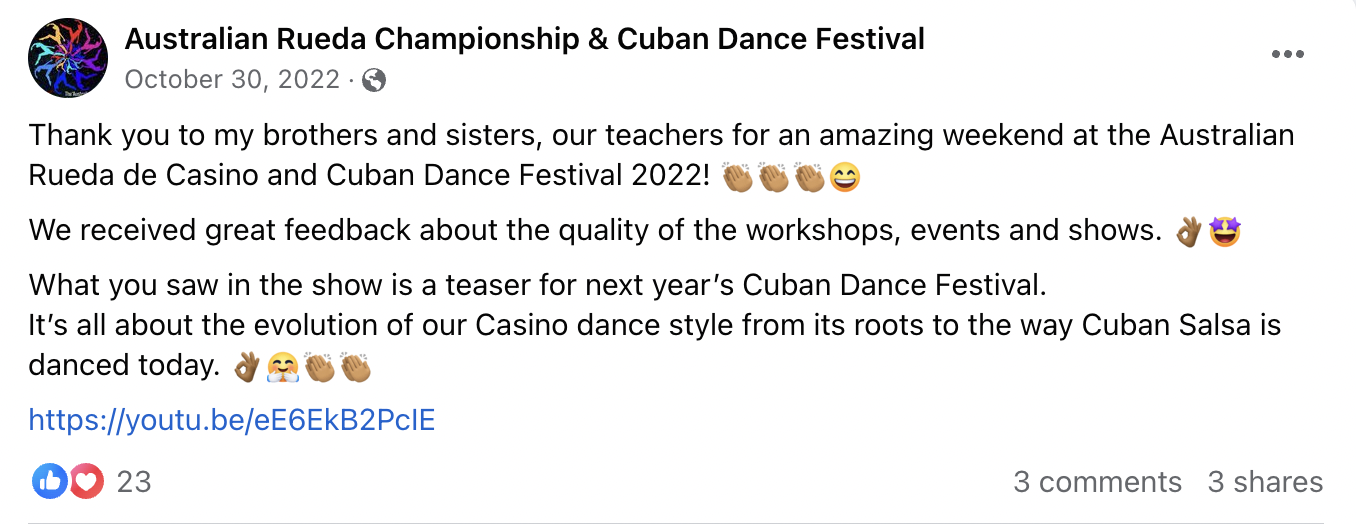
It struck me in particular how Eric Turro & Carolina Prieto’s demo, which was the one bearing the label Casino came before several presentations bearing various labels such as Cuban Salsa, Timba and Salsa-Rumba fusion, which were disparate in nature but had two commons traits. Firstly, they predominantly involved back-stepping (by both lead and follow) as opposed to the predominant forward-stepping that was apparent in Eric & Carolina’s dancing, and as a result were visibly more stationary in nature. Secondly, they involved a significant portion of time in what has come to be labeled suelta, i.e., dancing without immediate physical connection between the leader and the follower. This got me wondering: Was this supposed to entail that backstepping and/or disconnected dancing were somehow more recent forms of Cuban dancing? And if so, could you make the case that they represent an instance of evolution?
I had by then watched Eric Johnson & Sarita Streng’s documentary about the 2006 Guanabacoa Rueda de Casino team whose members had learnt from and improved upon the dance patterns of the older generations, including some of the so-called Fundadores de la Rueda de Casino (check out this blogpost!). I had also taken an interest in examining footage from the 1980’s Cuban TV show Para Bailar and, especially, the 2004-2006 TV program Bailar Casino. Based on such (admittedly limited) sources of information, my own personal analysis was that backstepping existed prior to the emergence of forward-stepping in Cuban dancing. If anything, forward stepping seemed to be not only a more recent development, but something that you could model and explain in terms of evolutionary science.
Whilst I am primarily a linguist, doing fieldwork amongst small-scale, ethnically minoritised agrarian communities of rural Yunnan Province in China has increasingly led me to veer towards the field of anthropology. This has been especially true of my most recent fieldtrip (May-July 2024), where I devoted plenty of time to conducting full-blown ethnographic interviews and collecting principled data on the origins and transmission of culture-specific practices, such as a unique type of gestures that pervade both everyday conversations and mythical narratives. More generally, my overarching interest in the complex interconnections between language, culture, embodied cognition and the physical environment has led me to learn a lot about the principles that explain and give rise to collective social practices. In the following paragraphs I am going to try my hand at applying ethnographic and evolutionary reasoning to the dance of Casino. Whilst by necessity superficial and preliminary, this foray will deliver two key conclusions:
1- Since the 50’s, Casino in Cuba has evolved steadily to increasingly ditch back-stepping and adopt forward stepping. Though by no means a categorically required feature, forward stepping fulfils a number of criteria that make it a good example of cultural evolution.
2- In more recent decades, Cuban dancing, especially as danced outside of the island, has been strongly shaped by contexts dominated by individualistic approaches in socially loose and unstable communities. The patterns that obtain in such contexts do not represent a good example of cultural evolution.
Now that you know what I intend to prove, you need not read any further. However, if you do, prepare to go on an intellectual ride with me, one that will hopefully enrich your horizons and teach you new ways to think and talk about the dances you love.
Why do humans dance? An evolutionary take
A little while ago, I was sent a short YouTube video of Steven Messina, whose multimodal dance content I generally enjoy, that ended with the much-repeated maxim that “we dance to have fun”:
Don’t get me wrong, I do get immense pleasure out of dancing, and I highly value the sense of flow and presentness that it brings into my life. However, just “having fun” is most certainly nowhere near enough to explain the nature and the evolution of dance in human societies. Let’s see why!
Group dancing is a staple of cumulative cultural evolution in the human species. From the progressive circling dances of Yi herder-farmers in southwestern China where I conduct my ethnographic fieldwork (as per the photo below), to the communal healing ritual of Ju|’hoan hunter gatherers in Namibia, all the way to Rueda de Casino in postcolonial Cuba, humans over and over display a tendency to develop forms of socialisation that are defined by two key ingredients:
1- Rhythmical synchrony
2- Goal-oriented collaboration
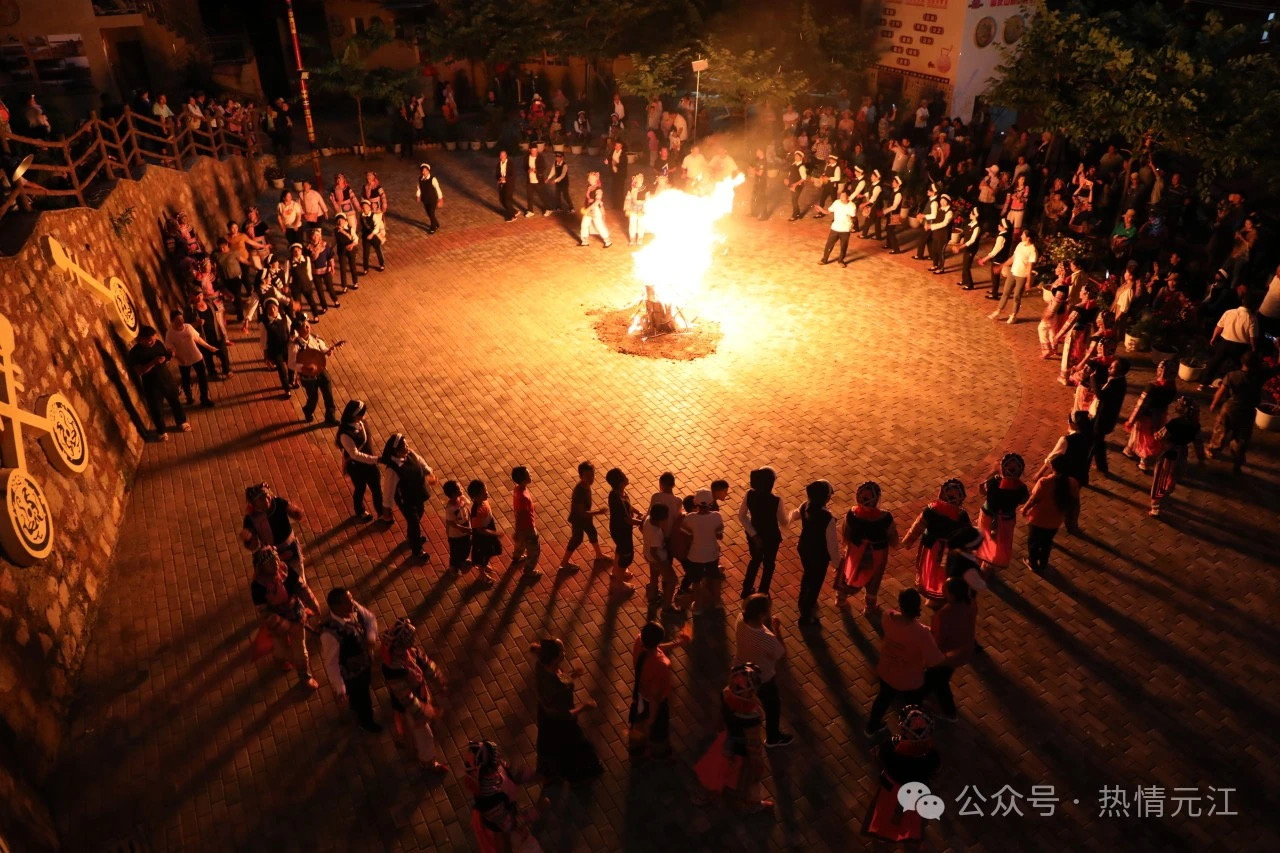
And for good reason! Group dancing harnesses the workings of our brains to produce one of the strongest forms of social bonding available to humans. This is because, as evolutionary anthropologist Joe Henrich (currently chair of human evolutionary biology at Harvard University) explains, synchrony exploits our mind-reading abilities in such a way that when we move in step with others, the mechanisms used to represent our own actions and those used for others’ actions overlap in our brains.
This convergence blurs the distinction between ourselves and others, which leads us to perceive others more like us, as extensions of ourselves. What’s more, one of the main ways that we humans use to process and engage with other people’s feelings and attitudes is by imitating their external cues (have you noticed that when you frown, your conversation partner micro-frowns as a way to better intuit what you are feeling?).
Crucially, during synchronous dances, our mental tracking system is flooded with “false” mimicry cues, suggesting that everyone likes us and wants to interact with us! These cues are all the more powerful whilst dancing to rhythmical music as the latter not only provides an effective anchor for individuals to sync up their physical movements, but also enhances the neuro-psychological potency of the act of dancing by engaging our sound-processing system and aligning it with both our visual and our sensory-motor systems. (cf. Henrich 2020, Ch. 5).
To put it simply: we dance to create a physiological and cultural sense of togetherness. This explains why group formats of dancing are particularly likely to emerge over and over across human societies.
This is interesting because for many people the first thing that comes to mind when they think about dance may be performative choreographies done by solo bodies expressing themselves on a stage to contemporary music. This is, however, a deviation from our species’ evolutionary norm, which can only come to feel normal through substantial cultural exposure to societies placing the focus on individual identity and expression, such as the Anglophone world. Nonetheless, almost entirely regardless of where and how you grew up, and this is crucial, even after a minimum of experience doing Rueda de Casino, you are likely to get an amazing sense of joy, flow and belonging when everything falls right into place in a perfectly synchronous manner during the execution of a dame. You are biologically primed to get a blast out of it!
Rueda de Casino as an evolutionary key: the emergence and spread of the forward step
From an evolutionary perspective, Cuba is a fascinating case study because it allows us to witness the emergence of a highly evolutionarily complex form of group dancing in a society in the process of (re)constituting itself in the aftermath of colonial upheaval.
Cultural evolution is the process by which societies gradually develop new ideas, technologies and patterns of behaviour driven by the accumulation of know-how through intensive social interaction and social learning. This process occurs in tightly connected communities where people systematically partake in shared practices like language, religion, or dance. As individuals learn from one another, small innovations gradually emerge leading to new combinations of existing forms, structures, and patterns. These new combinations typically lead to overall more complex practices, involving either or both more elements and an increased ability to fulfil a wider range of social functions.
For cultural evolution to occur, two key principles must hold true:
- There must be ample opportunities for people to develop increasingly complex innovations
- Such innovations must be learnable and actively learnt, which in turns requires them to:
- Provide a functional and/or social advantage
- Be easy enough to acquire (in context) by the average practitioner
I will delve into each of these factors below.
Opportunities for cultural innovation
In the Cuban context, a viable pathway leading to accumulation and complexification of dance practices was delivered by the availability of collectivistic spaces in which dancing is documented to have systematically taken place throughout the second half of the 20th century. I am talking about social spaces the likes of so-called Becas (interprovincial schools cum student dorms), Zafras (periods of sugar-cane harvesting), Solares (shared residential spaces encompassing multiple households), as well as dedicated venues devoted to dancing as a primary form of socialisation, involving both nightlife venues and so-called Círculos Sociales. Regarding the latter, the most famous one is of course the former Casino Deportivo de la Habana, which is at the origin of the name of Casino as a dance (see this blogpost), but also others such as Cristino Naranjo, Río Cristal, Patricio Lumumba, El Náutico, el Club Montañés, La Tropical, to name but a few just in La Habana.
As insightfully noted by Pepe Argot (RIP) —one of the so-called Fundadores of Casino— in this snippet from Johnson & Streng’s documentary film, if the revolutionary process had not led to the massive collectivisation of social organisation, it is hard to imagine how Rueda de Casino could have possibly emerged and spread in Cuba.
Indeed, a compelling case can be made that a combination of socio-economic structures, public policies and societal practices conspired to gather enough people frequently enough to catalyse a rapid process of accumulation and complexification of dance know-how. As we will see below, this is particularly true of spaces fostering not only a highly frequent engagement with social dancing, but also a competitive spirit geared towards producing locally distinctive, identity-enhancing innovations.
Crucially, the emerging dance know-how, whilst perhaps being advanced by gifted individuals or perhaps even more likely by unintentionally goofing around (as scientists now believe many great inventions emerge), could be reliably transmitted to peers and younger generations. This is because transmission was happening on multiple scales with a high frequency of learning events throughout key periods of acquisition, such as the teenage years. For example, social transmission of Casino has been documented to have been systematically happening in institutional and semi-institutional social spaces and events: the canteen in the corner, small-scale birthday parties, large-scale weekend social dance venues with live music (from the original Casino Deportivo to, more modernly, la Tropical de la Habana, and la Casa del Son in Santiago), and nation-wide dance competitions (e.g. Bailar Casino in 2004-2006).
Perhaps most importantly, socialised learning of dance know-how is also documented to have been happening in a person’s default living spaces, especially the household — think of those insight-rich scenes in Johnson & Streng’s documentary where Jorge’s daughter is learning off his father, mother and uncle [Check out this snippet!]. Given the important role that same-generational peers and clan-like groupings play in the acquisition of cultural systems (Labov 1964; Stanford 2008), there is good reason to believe that the Becas (public student dorms) likely played an equally (if not more!) important role in fostering the emergence and transmission of dance innovations. The Becas are not explicitly shown in Johnson & Streng’s documentary but you can check out this Facebook reel along with +1000 insight-rich comments by native Cubans, highlighting how going through them shaped their growth as social dancers.
This is relevant because it is fundamental for evolving cultural patterns to be not only socially useful and adaptive but also learnable.
Learnability
Simply put, cultural evolution requires that something be both learnable and learnt. What this essentially means is that for something to be passed down and improved upon, you need the right admixture of stable social contexts for cultural complexification, a reliable stream of opportunities for the transmission of information from more knowledgeable individuals and groups to less knowledgeable ones, and, crucially, a compatibility between the cognitive (and sensorimotor) requirements of the innovation to be learnt and the corresponding abilities of your average learner.
The more people are engaging in the same practices and the more role models are available for cultural learning, the more likely it is for emerging innovations to be maximally tailored to the social and cognitive profiles and needs of learners and, hence, the more likely it is that such innovations will get passed down to the next generation and recombined and improved upon in the process (of course by referenced to intersubjectively construed perceptions of what counts as “better”).
This is what evolutionary anthropologists tell us that cultural evolution is.
* * *
This simple definition has momentous implications for debates surrounding Latin dances. Suppose a particularly gifted individual (for example an academically-trained artist) spends thousands of hours practising, fooling around or consciously trying to improve on a social dance (for example Casino) by creating truly creative innovations. Unless the resulting practices invented by such a hypothetical dancer exhibit the right combination of functional usefulness, learnability and, crucially, social norms and spaces allowing its transmission to actually happen, they are extremely unlikely to spread throughout the wider dance community. In other words, they will neither be a good example of the relevant dance patterns, nor will they constitute a good example of cultural evolution.
In particular, choreographic patterns that are complicated from a sensorimotor and conceptual viewpoint and/or uniquely suited to an individual’s personal style and experiences are unlikely to become adopted by others and spread widely. These patterns often require extensive memorisation and high levels of dexterity without offering any clear functional benefits. But even if they did offer functional advantages, unless they are easy enough to replicate by a cohort of prospective role-models, they will simply not make it to the next generation.
Almost by definition, cultural evolution will tend to select against choreographing and styling that is too creative and individualised—think routines the sort of “raise right shoulder and stick the left foot out whilst twisting your wrists outwards with the middle finger lowered”, all of which is formally obscure ( that is to say, it has no obvious basis on everyday experience) and functionally opaque (it has no obvious goal).
Such ad hoc creativity is not necessarily rare. It’s just that its products are unlikely to be passed down and built upon. Revealingly, the transmission of practices that are too formally obscure and functionally opaque being unlikely to “just happen”, it often requires hierarchical regimes of strict social monitoring via ritualised apprenticeships —think of Yoruba deity dances or unintuitive ballet moves that no one really knows what they do or why but are revered by the force of their institutional prestige.
Let us step back for a split-second here… Evolutionary science tells us that, barring the imposition of certain practices by means of physical force or social control, failing to make the cut is indeed the fate of the vast majority of innovations and adaptations: they simply do not make it to the next generation. This does in no way mean that they are not part of the phenomenon. It also does not mean that they are illegitimate. But it does mean that they are not particularly good examples of cultural evolution!
Adaptations and innovations that do spread will have to have that golden combination of being useful, learnable and actively showcased and transmitted by a multitude of role models in the immediate social environments of a wide and relatively stable community of learners. Unlike formally obscure and functionally opaque choreographies, I believe these three traits do apply rather neatly to one particular mutation in the cultural history of Casino: the forward step. Let’s see why!
* * *
Following evolutionary reasoning, the emergence and spread of a forward step in Casino is exactly what you would predict would happen if Casino was frequently danced by regular groups of people and it was structured in such a way that one of the major joint collaborative goals was to reach a particular point in space at a particular point in time.
This, my dear reader, takes us to the main point of this article: functionally speaking, Rueda de Casino pretty much boils down to getting places in a socially collaborative manner!
This may seem obvious, but allow me to unpack it a bit.
Have you ever noticed how Dame 3, or even Dame 2, is rarely ever called in a back-stepping Rueda? My own observations suggest that these moves are likely to get called, nailed and immediately followed up by a subsequent (complex) move in a way that is directly proportional to the degree to which a given Rueda de Casino group is experienced and socially stable [see for youself how Dame 2 patterns in such experienced groups, courtesy of Julio Montero’s compilation].
Let us have an analytical crack at what makes a Dame 2, which I believe holds an important key to understanding the evolution of Casino. During a Dame 2, experienced leaders tend to (indeed need to) start moving towards the second-next follower on the first count of the second musical bar (the 5-count if you are dancing a tiempo) of the Dile que no motion (by the latest!) even as they dispatch their current follower by pushing them forward and out of the way for the next leader in line to have a practicable route. Likewise, experienced followers tend to (indeed need to) start moving forward on the 1-count so that they can reach a good angle by the 3-count which will then allow them to clear the way with precision timing on the 5-count and comfortably reach the destination (open position by 7-count) without shrinking the circle.
In other words: getting places in a socially collaborative manner!
Have you noticed how common it is for inexperienced casineros and/or Cuban Salsa dancers to shrink the rueda during Dames? It’s all in the back-stepping, which then requires dancers to reorganise and recalibrate.
Presumably, for collaborative motion to happen, you don’t just want to get places, but you also want some clarity and stability as to where these places are. Accordingly, back-stepping may have come to be selected against not only because it is less useful to get places but also because it introduces “noise” into the spatial and interactional layout (by shrinking, displacing or angling the Rueda formation). An important exception worth mentioning at this stage is apparent in the back-stepping of leaders during the first musical bar of a Dile que no (i.e., during the first 1-2-3-4 count), which as recently pointed out by Julio Montero in this wonderful interview, is (or at least was) commonly realised by many on-the-island Cubans as back-stepping. In this particular move, back-stepping on the part of leaders complements and mechanically facilitates the overall route of forward-stepping followers (via what is known in physics as angular momentum). Since such a pattern of motion can be interpreted as a useful manner to harness positional alternation for coordinated motion during group dancing, I would say it intrinsically responds to the exact the same functional principles giving rise to forward walking (i.e. getting places in a socially collaborative manner as a primary goal in Rueda de Casino).
Incidentally, some of you may have been frowning for a while at the fact that I take the Rueda format to play a primary role in shaping the nature of Casino, especially if you are familiar with the emphasis that some prominent Casino pedagogues (e.g., Carlos Ramírez, Eric Turro, Steven Messina, Ramsés Sariol and our very own Dáybert Linares) place on kinetic energy-transmission, i.e., leading-following as a core definitory feature of the dance (check out this blog post).
Is it not possible that the partnerwork format could have independently led to the emergence of a forward step that would have then spread through social learning?
Both pathways are theoretically possible. But the partnerwork-centred approach lacks a key ingredient: functional adaptiveness. While forward-walking could have, and likely did emerge independently via innovation and/or error by partnerwork dancers—perhaps even prior to the beginnings of Casino as such, i.e. in the eras dominated by Danzón, Son and Chachachá [click here to learn about the connections between Casino and these dances], there is no obvious reason why this should have ever come to be favoured as desirable.
The rueda format provides us with that key ingredient, whilst at the same time delivering a canonical type of social and interactional setting that is necessary for adaptive practices to spread. To put it simply, forward stepping is both adaptive in a rueda de casino and likely to spread, once it has emerged (probably many times independently in different regions by different individuals goofing around).
This is not to say that partnerwork hasn’t shaped the evolution of Casino, though.
A likely scenario, I believe, is a feedback loop whereby the Rueda format places selective pressures on partners within the group to move (and to lead-follow) either faster or more efficiently towards certain positions and destinations in ways that require both coordination (let’s get to position at the right time) and complementarity (let’s not get in each other’s way). Very particularly, the need to reach certain positions in time, including destinations relatively far away from the onset point of departure (think Dame 2), would have strongly pushed for individuals to eventually start walking towards those destinations by moving forward for as many steps as possible. The emergence of a forward step would have in turn opened up avenues for partnerwork dancers to lead and follow whilst advancing in both the same and complementary directions. Finally, individual dancers with more partnerwork experience and prowess in translatory motion—so-called desplazamientos—and forward stepping would have had a better chance at successfully innovating an increasingly complex yet socially transmissible array of patterns when dancing in the group format, thus cumulatively enriching what could be done structurally.
Evolutionary keys to help us begin characterising Casino as a dance
In the following two sub-sections I lay up a preliminary avenue for the ambitious-but-necessary project of describing and characterising what makes Casino, Casino using ethnographic and evolutionary reasoning. They are not crucial to the main claims of this piece as a whole. So, unless you feel like a brain workout, skip directly to the final section on why international Cuban dance (i.e. Cuban Salsa, Timba) cannot really be said to be the product of cumulative cultural evolution.
1. Functionally driven complexity
I finished the previous section suggesting that the cultural evolution of dances tends towards increasing complexity. But I have also claimed that formally obscure and functionally opaque patterns that are “too creative” are not likely to be transmitted.
And this is, indeed, the case.
When cognitive scientists talk about complexity, they don’t mean it in a colloquial sense as in, “Man! That’s so complicated and hard to learn.” What they refer to is the involvement of many simultaneously active systems, structures, possibilities that are highly flexible and holistic because they respond to broad functions (Barret 2017)—e.g., “enable a group of dancers to get places in a maximally collaborative way”—rather than narrowly defined concepts—”do precisely this sequence of moves at this particular point in time.”
Given the chance, dances, like all cultural phenomena, will become more complex. In particular, evolutionary anthropology suggests that complexity will be favored in the face of both competition and social interconnectedness amongst subpopulations (cf. Henrich 2016). Of course, complexity in cultural practices will develop and persist if it helps people adapt flexibly to recurring social situations where shared goals can be learnt and mutually shaped. This applies quite neatly to part of the sociological history of Casino, which has been marked by highly localised and specialised Rueda de Casino groups [check out this snippet from Johnson & Streng’s documentary!] with plenty of opportunities for inter-group competition and porous intermingling [check out this snippet from the same documentary!].
Without necessarily consciously understanding how and why they would be making decisions to dance in particular ways, nor how or why exactly their learning “works”, members of Cuban society who would have intensively and extensively partaken in the relevant environments (Casino Deportivo, las becas, etc.) would have had the most opportunity for cumulative cultural learning and transmission and hence for shaping the evolution of the dance by adopting and (fortuitously) recombining the practices of their multiple models. This would have led to increasingly complex patterns, that would have been highly learnable—in a particular household, Beca, Solar, etc.—and highly locally adaptive.
In contrast, dancers with little or no exposure to such settings are unlikely to have either played major roles in shaping the evolution of the dance or to have adopted some of the cumulatively emerging traits, such as forward stepping. Such dancers would be typically dancing simpler versions of the dance involving fewer stably occurring variables, fewer functional goals and less exposure to a wide enough set of experiences to consolidate functionally driven complexity.
Incidentally! All of those solo choreography videos flooding your Instagram feed may look complicated. But they are certainly not complex. At least not when compared to social dancing. Conversely, walking in sync with 7 other dancers from one position to the next during a Rueda de Casino or making sense of these words I am writing for you may feel quite easy (hopefully!), especially if you have had a lot of practice throughout your life. But don’t be fooled! Both of these things are underlain by tremendously more complex neurological and sociological processes than any choreography you will ever witness within or without the Cuban dance scene.
2. Functionally driven variation
Alright! So walking is more complex than choreographing. But how does complexity help us understand Casino as a whole?
The key point is that complexity both influences and is influenced by functional variation. In other words, the emergence and spread of increasingly complex innovations depend on the specific locally adaptive functions that are competing within and between social groups. To even begin answering what makes Casino, Casino we need to look at what functions it may have been burdened with in specific small-scale groups, and then look at the interaction between such groups. It may not seem intuitive, but an analytically powerful characterisation of the dance should be informed by an enquiry into questions such as:
- What are the social relations between the dancers in particular groups?
- What do they say or can be shown to be dancing for (e.g. friendship, romance, fitness, a regional identity…)?
- In what physical spaces is the dancing happening?
- What footwear is considered worth wearing?
- Why are the neighboring school kids coming to watch or not coming to watch this particular group dance?
The key to explaining what makes Casino, Casino is ultimately intimately connected to the question of how many people dance it barefoot on the dirt and when and why some others wear hard-to-get-but-pride-enhancing dance shoes.
Indeed, a key finding of the human and evolutionary sciences is that understanding the larger picture is willy-nilly impossible if we don’t understand the micro-level details of the contexts where functional human needs arise in real time (Tomasello 2001; Levinson & Enfield 2006).
An important consequence of such an approach is that we need to start taking contextual diversity and variation much more seriously.
Although I do believe there is good scientific standing to claim that forward stepping is a good example of cumulative cultural evolution, none of what I have claimed so far entails that forward stepping is a necessary or sufficient condition to define what Casino is or should be. Indeed, if the processes of cumulative cultural transmission were indeed at play, then what we would expect is for the transmission of practices such as forward walking to be unevenly distributed. That is to say, they wouldn’t be absolutely shared, but would depend on who is learning from whom, where, how and to what end.
In other words, while the forward step is adaptive under some conditions, it should not be seen as emerging from any sort of universal rational understanding or rule as to what is “most efficient”, “most optimised” or “more authentic” in a context-free manner.
Unless you ideologically shield yourself against the abundant evidence, it is pretty obvious that there is no such thing as a universal rule amongst Casino dancers dictating that you should (always) step forward. Indeed, while there is a wealth of footage of Cubans forward-stepping, you can also easily find back-stepping, side-stepping and on-the-spot-stepping (occasional or dominant) in dancers appearing in both Para Bailar and Bailar Casino, the two most important, indeed legendary! Cuban TV shows showcasing how Cubans on the island danced at the time of airing.
Instead of universals of human behavior, ethnographically grounded studies of human practices strongly suggest that what we should expect to find is patterns that are favored or disfavored under certain conditions (e.g. Evans & Levinson 2009). This is crucial because in order to properly arrive at a descriptive characterisation of a dance like Casino, we need to stop trying to find its true essence in terms of irrenounceable (sufficient and necessary) features. Instead, what we need to be doing is start out with functionally grounded empirical questions like “Who is dancing, where, and why?”. By necessity, this will lead to a gradient, multidimensional definition of what Casino is, which should account for prototypical and salient patterns (e.g. forward walking) whilst at the same time accounting for why those very same patterns are not always there, nor even do they seem to matter at all under specific circumstances.
Note that a context-grounded, functionally orientated approach is not bad news to those who favor a forward step in their Casino dancing and teaching endeavors. Variation is precisely consistent with an evolutionary approach. It does not in the least diminish the value or reality of forward-walking and translatory motion in Casino. If my hypothesis is correct and it is arguably the most experienced dancers who are most likely to forward step, and if forward-stepping is particularly likely in contexts with socially intensive transmission and inter-group competition, then this goes a long way towards supporting the idea that forward-stepping is in fact a genuine example of adaptive cultural evolution.
At the same time, there is good reason to remain skeptical about the back-stepping habits in the forms of dancing associated with the labels Cuban Salsa and Timba portrayed as more recent and “evolved” by the Australian Rueda de Casino Championship organisers in 2022.
The next section goes one step further in teasing apart this idea, asking from a scientific perspective whether Cuban Salsa can be said to constitute a form of cultural evolution.
Is Casino evolving, then?
Well yes and no!
The evolution of Casino dancing has been shaped by the specific needs of interconnected individuals in Cuba regularly dancing and learning from one another as part of their everyday interactions in key physical and social settings. Their continuous exchange and competition in tightly knit yet socially open communities has driven the development of Casino in certain directions, favouring certain functionally useful innovations such as the forward step.
This process of cumulative cultural evolution seems to have continued up to the present. I suspect there may have perhaps been a slump after what I like to call “The golden era of contemporary Casino,” centered around the Bailar Casino editions 2004-2006. This would be to an important extent due to a very real loss of access to institutional live-music and dance venues on the part of common Cuban citizens, recently highlighted by Nicole Goldin in this beautiful interview.
That said, there are some signs that Casino is very much alive today. There appears to be a renewed public interest in and funding allocation to Casino-centred spaces and activities directed at younger generations and the population at large, which is most clearly embodied by the large-scale bi-national project known as Retomando el Son Bailando Casino that has undertaken to reinvigorate Casino in Cuba and consolidate large-scale stable communities of socially interconnected casineros in Venezuela in indirect dialogue with the relevant Cuban communities.
Judging from recent footage largely made accessible by Jorge Luna Roque in Cuba and Luis Llamo in Venezuela, the Rueda de Casino format is once again taking centre-stage in various dedicated social spaces and events. For our purposes, two key things stand out. Firstly, forward stepping and dynamic translatory motion seem to be quite widespread, especially amongst couples and groups displaying substantial prowess and group-based cohesion. Secondly, new generations of teenagers and young adults are getting actively involved in such spaces, which seems to be an explicit policy goal on the part of relevant cultural promoters like the Cuban (and the Venezuelan) ministry of culture.
There are some important differences in the Casino practices of 2004 vs 2024 that could potentially be tracked to a loss of key transmission lines and a corresponding reduction in complexity. In this regard it is perhaps particularly revealing that there is a drastically reduced rate of enrolments in and institutional support for preuniversitary educational institutions known as becas or pres. For example, the legendary Vladimir Ilich Lenin Pre founded in 1974 in La Habana and originally designed to host 4500 students has been recently documented to be in a state of utter disarray and at most boasting a cohort of around 110 students (Check out this, this, this and this article if you read Spanish). However, the current involvement of the youth in Casino-related activities is a sign that intergenerational transmission and cumulative cultural learning are (back) on track in a direction consistent with the overall evolution of Casino in recent decades.
But what about Cuban Salsa and so-called Timba, then? Are these forms of dancing evolutions of Casino? Are they actively evolving dance forms?
Well… Not really! Not from a technical, science-informed viewpoint.
An evolutionary interpretation of what these phenomena represent can be essentially broken down into the following two lines of reasoning.
First, recall from the introductory section that these two labels (alongside a plethora of others with less currency in the marketplace of dance names) do not necessarily represent a coherent set of practices. In fact, in particular Timba often refers to a bewildering array of ever-changing choreographic designs created and ditched almost as swiftly as this year’s summer fashion trends. Other posts in this blog have dealt with globalised consumption markets and the dynamics they impose onto cultural practices (Check out this blogpost!), so I will not say anything about this issue here. I would like instead to highlight the evolutionary implications of the fact that Cuban Salsa and Timba are primarily happening in a particular type of environment, namely one that defies the conditions under which cumulative cultural evolution can happen. Consider how:
- Cuban Salsa is highly limited in terms of shared spaces for naturalistic socialisation.
- The populations learning (and teaching!) Cuban Salsa are highly socially atomised, i.e. only loosely connected, unstable, inconsistent.
These two points, as you may already guess, strongly suggest, that there is little ability for Cuban Salsa to be effectively transmitted in ways that enable cumulative cultural learning and complexification. There is just no social fabric for it.
Instead, I suggest that Cuban Salsa is mainly transmitted, however imperfectly, via ritualised pathways mediated by prestige and authority. I don’t know about you, but doesn’t Cuban Salsa seem overly simplistic and rigid? I can’t count the times I have seen Cuban Salsa dancers reprimanding one another (or me for that matter) on the dancefloor for not doing the moves in “the right way” without providing any clear socialised avenues for acquiring them. Cuban Salsa dance events often seem structured in a way that limits social learning, innovation, and the mixing of new ideas—the key elements of cumulative cultural evolution! Mind you, this seems to apply just as much to international Casino, except, perhaps, in those few instances where it is founded upon pre-existing community networks with a real-world, cohesive social fabric, as best embodied by not-for-profit groups such as Dile que NOLA and DC Casineros (on which you should check out this interview!).
Second, while the terms Cuban Salsa or Timba are very fuzzy folk categories, recall from the intro that there are two key features that tend to obtain across their various different varieties:
- A tendency for stationary dancing linked to backstepping, side-stepping and on-the-spot stepping.
- A focus on individual expression enacted via:
- Ritualised, aesthetically heavy and functionally opaque choreographing.
- Kinetic disconnection through suelta.
From a socio-evolutionary viewpoint, both of these features are pushing in the opposite direction of cumulative cultural evolution, as they, crucially, decrease, rather than increase, functionally broad complexity in social dancing, very particularly when applied to a group format.
Interestingly, this situation mirrors to an important extent the fate of cultural practices that at some point start being routinely learnt by outsiders. Ground-breaking research in linguistics and anthropology has shown how languages and other cultural practices can become substantially simplified and altered in situations of sustained contact with outside-groups, for example when there is a sustained influx of in-married exo-ethnics into a given village.
The idea behind this theory, is that the density of shared information (i.e. how much information you share with your social peers) largely determines how reliably cultural practices will be transmitted and, crucially, how likely they are to evolve novel adaptive innovations. Don’t get me wrong, there is also a lot of evidence that learning from outsiders can greatly catalyse the process of producing new, useful innovations. But, crucially, when you reverse the direction and what you get is a large number of outsiders learning a given practice, the practice itself is likely to get both simplified (Trudgill 2001; Bentz & Winter 2013) and altered in directions that make the practice more compatible with the socio-cognitive needs of out-group adult learners, which, by definition, have a limited capacity to acquire cultural and cognitive systems different from those already acquired in childhood (Wray & Grace 2007; Lupyan & Dale 2010).
Indeed, beyond a reduction in overall complexity, contact-induced changes often do mirror patterns of belief and behavior that are common in the culture(s) of the adopters and/or in the novel settings where the learning is happening. Perhaps, a whole’nother article might be needed to fully unpack this idea, but it seems obvious that the focus of Cuban Salsa/Timba on individual expression and disconnected dancing reflects concepts and beliefs about dance as a performative, aesthetic (rather than social) experience, as well as beliefs about the primacy of individual expression and individual autonomy in social practice and psychological identity.
Do you see yourself as an individual atom making mostly autonomous decisions whilst occasionally interacting with other atoms, like so-called W.E.I.R.D. societies tend to promote (acronymic for Western Educated Industrialised Rich Democratic, cf. Henrich et al. 2010)? Or do you, on the contrary, see yourself as deeply enmeshed in textured networks of co-responsibility and interdependence, as for example East Asian and, to a lesser extent, Southern European and Latin American societies favor (Nisbett 2003)?
I must concede. The whole situation is more complex than I am depicting. It is for example quite possible that the stationary nature of Cuban Salsa and Timba is historically related to and in a sense partly represents a continuation of forms of Casino dancing predating the evolution of the forward step, i.e. Casino as danced for example by “Los Tradicionales” a very much authentically Cuban Rueda de Casino group of 80-year-olds from la Habana where systematic backstepping is (was) the norm (see for yourself in this snippet from Johnson & Streng’s documentary). It is moreover quite conceivable that Cuban Salsa may have started to resonate with and be practiced by on-the-island Cubans who were not as culturally experienced with the more complex, i.e. forward-stepping, varieties of Casino dancing (although as forcefully argued, among others, in this post, this seems to be mainly restricted to the dance tourism sector).
It is also possible that forward-stepping may have receded in Cuba itself from the late 2000’s following a loss in spaces for stable transmission enabling the spread of functional innovations predicated upon complex joint goals, such as dancing in demanding and competitive ruedas. Complexity can certainly be undone without any major influence from out-groups. Several human populations are widely attested to have decreased in cultural and technological complexity throughout our evolutionary history as a result of social atomisation, i.e. the loosening of social networks and a reduced exposure to models for learning (cf. Henrich 2016).
However, even if local trends towards simplification could be demonstrated for Casino dancing on the island, a key conceptual clarification is needed here!
While complexity reduction, which, as I am arguing, stationary and disconnected dancing would be good examples of, is a type of change, it is not a good example of evolution. When a population loses the ability to make fire, craft long-range canoes or dance highly complex Rueda de Casino, this is not an example of adaptive evolution but on the contrary a symptom of a disruption or an upheaval in the natural course of evolution. At least under stable socio-environmental conditions, the natural processes of cumulative cultural evolution have crucially been described as autocatalytic, i.e., self-reinforcing (cf. Henrich 2016, Ch. 15-16). In other words, Generation 3 is likely to be more complex than Generation 1, with Generation 2 in between. This is unless ecological disruptions lead to famine, war erupts, a village is abruptly invaded by outsiders or Generation 3 happens to be made up of less socially cooperative, poorer cultural learners, more prone to splitting off into smaller, less interconnected groups.
It’s kind of obvious when you think about it, isn’t it? Neither the human-induced extinction of the Tasmanian thylacine (check out the wikipedia article immediately if you haven’t got a clue what I am talking about!), nor the genocidal elimination of Tasmania’s aboriginal population and their cultural practices are good examples of evolution.
Likewise, a hypothetical disappearance of Casino or its subordination to Timba would also not be good examples of evolution. Herein lies the quid of the question. Public commentators like Gastón Carvallo in this recent interview on a Barcelona-based Cuban dance event, are using the term evolution as if it were interchangeable with change or replacement which is simply put both prescientific and pretentious.
Overall, at least as regards the international Cuban dance scene centred around hyper-prominent individuals promoting stuff with their own unique creative imprint on the basis of either or both prestige and authority, Cuban dance cannot be said to be evolving. Not even can it be said to be properly subject to stable pathways of cultural transmission. In that scene Casino is, I would argue, only vaguely present in a highly abstract and schematic manner. Rather than evolving, it gets ongoingly replaced through a cluster of disparate practices periodically recodified and imperfectly transmitted to sporadic, socially atomised exo-ethnic learners in a whirl of ever novel unstable contexts. The twofold mixture of hyper-individualisation and the lack of an organic social tissue means that Cuban Salsa and Timba almost by their very nature preclude cumulative cultural evolution, though locally there may of course be grey zones.
Next time someone tells you that you need to (chill and) embrace evolution, I hope you will be able to unpack what their comment can and cannot explain and prescribe, at least for yourself.
References:
Barrett, L. (2017). How emotions are made: The secret life of the brain. Boston: Houghton Mifflin Harcourt.
Bentz, C., & Winter, B. (2013). Languages with more second language learners tend to lose nominal case. Language Dynamics and Change 3. 1–27.
Evans, N., & Levinson, S. (2009). The myth of language universals: Language diversity and its importance for cognitive science. Behavioural and Brain Sciences 32. 429–448.
Henrich, J. (2016). The secret of our success: How culture is driving human evolution, domesticating our species, and making us smarter. Princeton: Princeton University Press.
Henrich, J. (2020). The WEIRDest people in the world: How the West became psychologically peculiar and particularly prosperous. New York: Farrar, Straus and Giroux.
Henrich, J., Heine, S., & Norenzayan, A. (2010). The weirdest people in the world. Behavioural and Brain Sciences 33. 61–135.
Labov, William. 1964. Stages in the acquisition of Standard English. In Roger Shuy (Ed.), Social dialects and language learning (pp 77–103). Champaigne: National Council of Teachers of Education.
Levinson, S., & Enfield, N. (Eds.) (2006). Roots of human sociality: Culture, cognition and interaction. London: Routledge.
Lupyan, G., & Dale, R. (2010). Language structure is partly determined by social structure. PLoS One 5(1).
Nisbett, R. (2003). The geography of thought: How Asians and Westerners think differently … and why. New York: Free Press.
Stanford, James. (2008). Child dialect acquisition: New perspectives on parent/peer influence. Journal of Sociolinguistics 12(5). 567–596.
Tomasello, M. (2001). The cultural origins of human cognition. Harvard: Harvard University Press.
Trudgill, P. (2001). Contact and simplification: Historical baggage and directionality in linguistic change. Linguistic Typology 5. 371–374.
Wray, A., & Grace, G. (2007). The consequences of talking to strangers: Evolutionary corollaries of socio-cultural influences on linguistic form. Lingua 117(3). 543–578.
ABOUT MANUEL DAVID GONZÁLEZ PÉREZ

Manuel David González Pérez received a PhD in Linguistics at the Australian National University (2022) under the direction of Nick Evans, the world’s foremost expert on linguo-cultural diversity. He currently works as a Postdoctoral Research Associate at the University of Sydney and is a recipient of an Endangered Languages Documentation Program Fellowship to document indigenous languages and cultures of rural China. Beyond his academic endeavours, he loves swimming and most of all social dancing. He is particularly passionate about Cuban music and Casino. When not on fieldwork in small-scale Trans-Himalayan villages, he acts as director of the Sydney Gay Casineros. Founded during World Pride 2023 (held in Sydney), SGC is intended as a not-for-profit community project providing a weekly safe space for same-sex Cuban dancing. Given his intellectual inclinations and training, he also enjoys applying an analytical prism to all things that matter to him in life, including Casino.
 Son y Casino