
I have always wondered why Cubans do not speak out about what they see happening to casino abroad. At first, I attributed it to the fact that the Internet was not as available in Cuba, and so not a lot of Cubans had visual access to what was happening. Then, when the Internet did become more accessible, and I still did not see Cubans talking about it, I thought, “Of course. Why would they spend their costly data watching dance videos?”
The absence of Cubans speaking out against what has happened to casino abroad made me feel like I perhaps cared for something that most Cubans did not care about. And since I was one of the few Cubans actively talking about this online, it made me feel very alone. Because there were not many voices on cyberspace saying the things that I say, some people may have perceived this blog as the rantings of someone who simply cannot accept that things have changed, that I was holding on for dear life to an outdated mode of thinking–and dancing. Casino had “evolved”–as many of those people like to say–and here I was, resisting the change. To some, I sounded “bitter”.
Then something happened that I had not expected. In 2023, I traveled to New Orleans in order to present a lecture on the production of Cuban dance music between 1959-1990, as part of Dile que NOLA’s Toda la Familia Weekender. The event was, hands down, the most fun I have had in a long time, and I’d recommend attending future iterations in a heartbeat to anyone who asks. During my time there, the event organizers recorded me dancing with several people. Among them was the Cuban wife of one of the organizers. Some weeks after the event concluded, the organizer in question uploaded a video to the group’s Facebook page of me dancing with her wife for the first time.1
The video received over 95 thousand views on Facebook, more than 4 thousand reactions, and hundreds of shares and comments. If I am not mistaken, for a while, this video became one of their most successful uploads on the platform to date. It certainly was the first one to achieve 99% positivity in the comments section.
As I said earlier, I was not expecting that.
Neither was I expecting the outpouring of love and positive affirmations that my community showed me.
You see, the hundreds of comments that video has? Most of them are from Cubans. Cubans who saw the video and felt identified with what they saw, with how my partner and I were dancing. Cubans who saw casino, and said:


Scrolling down the comment section, a thought struck me, and I hit myself on the head for not having realized this earlier: Cubans do not speak out online against how badly or inauthentically casino is danced outside of Cuba by non-Cubans, or even by Cuban teachers. Not generally, anyway. Instead, Cubans comment when they see the real thing, when they see themselves reflected in the dance. When they see their own dancing casino or they see outsiders dancing casino and respecting the way it is danced in Cuba. That’s when Cubans comment.
If you also noticed, these Cubans used the words “pure”, “original” and “authentic” in their praise of my dancing, and mentioned–to then dismiss–“made-up things or fusions…” In other words, Cubans were not only affirming the way I was dancing casino, they were also critiquing the ways in which they see their dance reshaped abroad.
And that…that needs to be talked about in a lot more detail because, for a long time, criticizing a video because it shows something that is not authentically or purely Cuban–even though the people who upload the video call it “Cuban”–has been associated with a certain “rhetoric” from a certain person in the Cuban dance community abroad (more about this shortly). For a long time, commenting on a “Cuban” dance video and saying that it is not Cuban enough or criticizing the ways in which whatever is danced in those videos is “made up” has been seen as a fringe way of thinking, the antics of a deranged individual and his followers. At times, when I say something similar, I get instantly associated with this person. Other times, I get called “divisive”, followed by a very condescending question of, “Why can’t we all get along?”
And yet these Cubans are saying the same things, using the same words.
What I will try to explain to you–the outsider, the non-Cuban–on this post is that a lot of regular Cubans (that is, not dance instructors) do not like or approve of what people are doing to their dances outside of Cuba–and even within Cuba, as you will see later on. They are just not going to your videos and telling you.
During the month of February of this year, I decided to do a “Cuban Salsa Detox” on the Son y Casino’s Facebook page. To quote myself, the detox was “ a video series which purpose is to educate the public about how CASINO is danced in Cuba. The idea of a “detox” is to get rid of something from the body. Similarly, through daily exposure to authentic CASINO clips, this video series seeks to get your mind rid of all the inauthentic ideas and concepts that “Cuban salsa” instructors/videos have created about how Cubans dance.”
The detox was a tremendous success.2 On numbers alone, before the detox, Son y Casino’s Facebook page had a following of about 2700 people, after 10 years of existence. During the detox, in less than a month, the numbers of followers more than doubled. Right now, it’s close to 6400 followers.
But the metric that really mattered to me was who was getting to Son y Casino’s page. Since the inception of the blog in 2014, the majority of Son y Casino’s audience has been mostly non-Cuban. And that makes sense. It speaks to the fact that I have mostly written to educate non-Cubans about my culture.
During the month of February, however, close to 80% of the people who began following my page during the detox were Cubans. So what changed?
Well, two things. The first one is that the detox was video-based, and the algorithm likes that. Most of the time, I update the Facebook page with a link that sends people outside of Facebook (i.e. here). That’s not what Facebook–or any other platform of its kind–wants. It wants to keep you consuming content inside it. So the algorithm rewards content that keeps people in–like videos and reels. And then, every comment, share, and like, helps visibilize the post even more.
The second factor–and this is the one I like to think was the most influential–was the content of the videos themselves. All the detox videos were of regular Cubans dancing casino. Not of Cubans teachers teaching a class abroad or doing a demo. Or even Cuban teachers in Cuba teaching to non-Cubans. Cubans, in authentic spaces (a house, a gathering, a concert, a competition) dancing casino. And the Cubans who saw these videos, much like what happened with my own video that went viral in the Dile que NOLA page, identified with that. They saw a page where casino was called casino that posted videos of casino danced authentically, and they felt safe to comment.
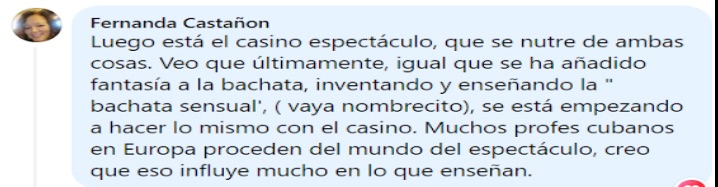
What is more telling: many of them aired their grievances about what they are seeing happen to casino. What you are about to read is a compilation of the many comments that Cubans left on the Son y Casino page during the detox. These comments speak to the angst stemming from noticing what is happening to their dance abroad, coupled with the happiness of seeing casino danced authentically amidst the plethora of fusions and made-up things (inventos, fantasías), clowning around (monerías, payasadas). I’ll let you read for yourself.

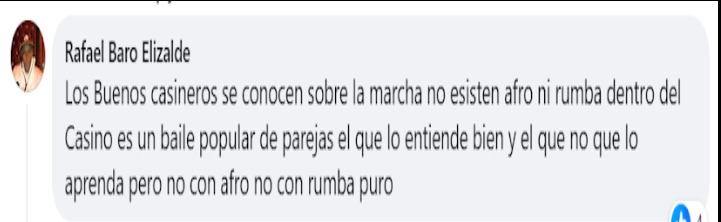

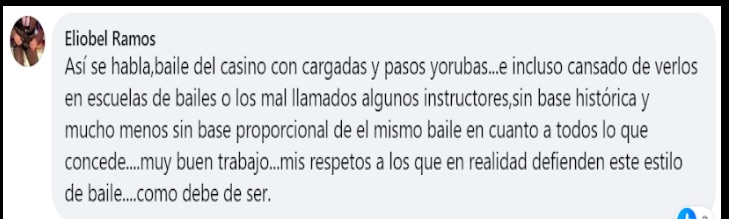 Well said, casino dancing with with lifts and Yoruba steps…and I’m eben tired of seeing them in dance schools the badly-called “instructors”, without any historical base or understanding of the dance itself…very good job…my respects to those who really defend this style of dancing…as it should be done.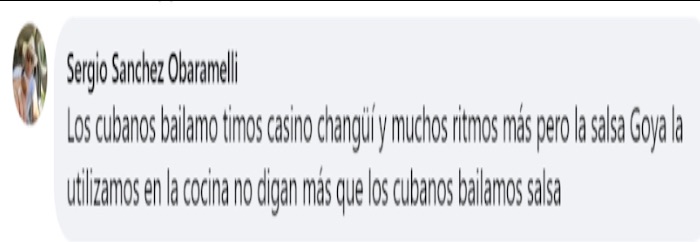


Acrobatics are for Cirque du Soleil.

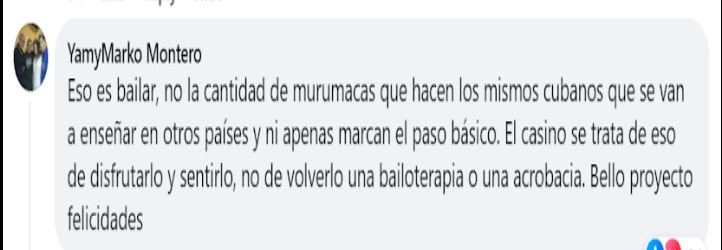


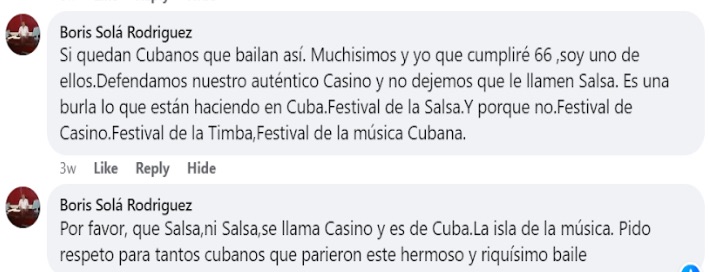
Please, stop calling it salsa. The name is casino and it is from Cuba, the island of the music. I ask for respect for the many Cubans who birthed this beautiful and joyous dance.
* * *
As you can see, many Cubans are not happy with what has and is happening to the dance of casino abroad. Perhaps this is news to you, and that is precisely the point of this post.
That, and to make the following copiously and abundantly clear:
The Cuban dance community abroad needs to normalize this discussion. This discontent from Cubans with what is happening to casino, which everyone should be paying attention to (because, hello!, the dance is from Cuba), needs to stop being classified as “divisive”.
Let me explain what I mean.
Recently, the following video went viral on the Cuban dance community (via the views on YouTube, it does not seem so, but if you look on Facebook, for instance, this video was watched and shared a lot).
I get why it went viral. Yanek and Diana are the renowned dance couple that, in my view, really propelled an interest in casino outside of Cuba. Indeed, Cubamemucho, the event where Cuban dances first began to gain traction in Europe and opened the door for so many Cuban bailadores and bailarines (all of the ones I mentioned above included), happened after the Para bailar casino competition that Yanek and Diana won. Who doesn’t remember the two of them dancing to Manolito Simonet’s “El diablo colorado”? In fact, I think it is safe to say that Yanek and Diana are to casino what Ataca y La Alemana are to bachata in the sense that, without them, I do not think the dance would have reached the popularity that it did outside of the island.3
I say this because I had a lot of respect and admiration for Yanek and Diana when I first started to learn casino. As I am sure happened with other people, Yanek and Diana became my reference point for casino in many ways, and I would always recommend their video to anyone interested in learning more about casino. I spent hours watching them, trying to figure out how they did what they did, knowing I would never come close to being as good. I still do not come remotely close.
And so it was super disappointing when I saw what they were doing on that video. Whatever they were doing had so much influence of outside factors that, at times, it was barely recognizable as casino (and if you are not Cuban and you disagree with me on this, I need you to understand that whatever you think you know about actual Cuban dance culture, you do not; and I say this in the nicest way I can).
And that viral video stands in such a stark contrast with this video of Yanek and Diana teaching casino in Cuba.
I first saw the now-viral video on the Dile que NOLA’s Facebook page.4 Here I was, scrolling down my feed, and the video popped up unexpectedly. As I mentioned, I was very disappointed with what I saw, and I left a little comment: a “vomit” and “shrug” emoji. That was it. I wasn’t critiquing Yanek and Diana. I was critiquing what they were doing. In short, I was just trying to convey my severe dislike for what I was seeing happen to the way my dance culture is being commodified for the outsider’s approval and applause. And the shrug was more along the lines of: It is what it is. This is how the world works.
Apparently, my feelings about how I saw my culture portrayed crossed a line.

To this person, to criticize the ways in which Cuban dance culture is portrayed, fetishised, and commodified abroad, is to be automatically associated a certain “Yoel Marrero”. As such, my comment is “inadequate”.
And we need to unpack what that means.
In the early 2010s, a person emerged on YouTube and the Cuban dance scene at large who was unlike anyone out there teaching casino at the time. He dressed in a 1950s dress code, called the dance “casino” instead of “Cuban salsa” or “salsa casino”, and had a methodology for learning casino (which no other teacher can truthfully say they did): the Método del Cuadro del Casino, or MCC for short.
This person was, of course, none other than Yoel Marrero.
Now, I have written extensively about my own journey with YM and all the mental health damage that he and his followers caused me. I am not going to go into that here. The post is here on the blog for you to read whenever you want, if you have not done so already.
YM is both the best and the worst thing that has happened to casino outside of Cuba. On the one hand, YM did a lot of good things to elevate casino outside of the island, centering the authenticity of the dance above capitalist market forces that simply sought to consume culture without much care for the way in which it consumed it. On the other, his toxic rhetoric made it almost impossible to criticize the very same capitalist market forces under which casino is taught, for any type of criticism would be instantly associated with him, his blatant racism, sexism, homophobia, his vicious attacks to people all over the community, and his often-unhinged behavior.
In other words, shit like this:

Let’s put that aside for now. I will engage with this later.
When I found YM, I did so after I having become thoroughly exasperated by the ways in which my culture was treated abroad, as I extensively explained in this post. Back then, a lot of people thought this was “casino”–and by extent, Cuban. The video below was widely watched by many during that time (part 1 actually has 2 million views). And yet these are not Cubans. From the accent I hear, they seem to be from Argentina. Neither is the song Cuban, as they are dancing to the Puerto Rican singer Andy Montañez’s rip off of Manolito y su trabuco’s “Locos por mi Habana”. You can see how problematic it is that videos like this one became the reference point for what “casino” was:
It isn’t hard to guess, then, why I found YM like such a breath of fresh air. Again: he was calling the dance casino, and, despite the outdated dress code, his method produced something very close to the casino I knew and watched in Cuba. That was the main appeal of YM, not only to me, but to many others at the time: authenticity in the face of so much distortion.
Then came the attacks, and everything went to shit.
When his business and his method did not lift off as he wanted it to, he started fighting with people online, mostly with other Cuban instructors–out of spite of their success, out of frustration, who knows–but everyone was fair game. His whole point was that they lacked integrity and were lying to people for the sake of money.6 He was not wrong about this. Many Cuban instructors were and still are contributing to the distortion of Cuban culture abroad, teaching something that has very little to do with how Cubans in Cuba dance, but rather with how non-Cubans want to experience Cuba. The criticisms were valid, and I, for one, supported them. In fact, I’ve done my share of criticizing that on this blog, while offering some context.7
That said, YM had the wrong diagnosis. Yes, people taking advantage of others by selling them false information is a problem. However, this is simply a symptom of a bigger problem: the capitalist, neo-colonial system that places the needs and desires of non-Cubans interacting with what they want Cuban dance to be above the ways in which Cuban dance is actually experienced in Cuba. When we consider this, the culprit is pretty much everybody who participates within that system. And that’s kind of the point, we all have to think about the ways in which we engage with a culture not our own, and the ways in which we uphold, knowingly or not, the systems of power that commodify a culture for the entertainment of others.
At any rate, YM didn’t go after capitalism, or did not frame his criticism within a neo-colonial lens to then critique power structures. He went after people. And in doing so, the comments began turning ugly. You’ve already seen his Hitler profile picture that he uploaded when people began calling him a racist after he began calling black Cuban teachers “monkeys”.8 You can guess what he was saying to women and to LGTBQ people. Since he did all of this very publicly online, YM, for many, became the one Cuban outside of their teachers with whom most people directly or indirectly interacted online. Many people saw their friends and close ones suffer because of YM’s vicious, personal attacks. That is not easily forgotten, nor forgiven. Because his rhetoric is laced with racism, sexism, antisemitism, and homophobia, coupled with threats of physical harm, these more toxic and problematic aspects of what he said, including the ways in which he characterized his method as the way to learn authentic casino, became conflated with the other things that he was saying, namely the criticism of the state of Cuban dances abroad9.
And the effects of that are still felt today. Namely, because YM was the loudest voice talking about what was happening to casino abroad, any similar criticism often gets met with a comparison with him. And of course, when you get associated with YM, people who have heard of him or know who he is and what he has done to others will instantly shut you off. And now you understand why that person who commented on my emojis associated me with YM.
Part of the point of this post, then, is to learn to disassociate YM’s toxic rhetoric from a more nuanced conversation about cultural appropriation, neo-colonialism, and market dynamics under capitalism.
The other part is to to actually validate this criticism about the state of Cuban dance and culture abroad. As you have seen, YM is by no means the only Cuban criticizing what is happening to casino abroad. The question, then, becomes, why are you not aware of this?
* * *
Before I finish this section, let me make something clear: MCC does produce casino. Despite the shortcomings of YM as a person, his method replicates casino as it is danced in Cuba. No matter how much you hate hin–and I personally do, a lot–you cannot objectively deny that. And that’s important to recognize, because you can separate the product from its creator. In fact, I do it all the time when I listen and dance to Los Van Van, whose former leader, Juan Formell, was always a staunch supporter of Castro and his communist regime.
To this point, the following comment from an old-school casinero currently living in Cuba speaks volumes to the of the utility of the MCC in learning to dance casino authentically.

Every single person this old-school casinero living in Cuba mentioned trained, learned or improved their casino under YM’s method. As such, whatever reservations you may have about YM as a person–and I personally have a lot–if we are being objective and disassociating the author from the work, we can objectively say that the MCC does replicate casino in the way that it is authentically danced in Cuba by regular people. Otherwise, someone who lives in Cuba and dances casino there would not identify with it.
This is not to say, however, that MCC produces culturally conscious casino dancers. On the contrary, thanks to YM’s continued derangement, his method has now become an extension of his delusions of grandeur, where he holds the key to the dance of casino, and no one else does. The other day, in fact, I had to deal with a follower of his who claimed that in Cuba no one knew how to teach casino. What is actually true is that non-Cubans cannot easily learn casino as Cubans teach it. But it’s easier for a non-Cuban to blame Cubans rather than hold up a mirror to oneself and analyze why they expect their paradigms for learning to work on cultures different from theirs (hello, neo-colonialism, I see you hard at work!)
In a sense, what YM and his MCC are doing now is creating a group of non-Cuban casino dancers who now feel empowered to claim that what they dance is better than what Cubans do. Their casino–“casino MCC”–is above that of Cubans. They are better than Cubans. No wonder so many neo-Nazis and closeted white supremacists follow this man.
I hate myself for having given YM this much space in this post. However, I needed to contextualize things for this next part to make sense.
We need to stop seeing criticism of what is happening in the Cuban dance scene abroad as “fringe” or divisive. It evades the conversation of a larger systemic issue: the commodification of Cuban culture under a capitalist market. In fact, I would posit that this criticism only sounds peripheral because a lot of people who are part of the Cuban dance community are, ironically, not in contact with regular Cubans–and no, I am not talking about your instructors: I am talking about people who have nothing to gain from you by interacting with you. Because of this lack of interactions with the people whose very culture they consume, non-Cubans do not really know how Cubans feel. Additionally, comments critiquing the state of Cuban dance abroad are not personal attacks. The person is not being critiqued. Their role in upholding the systems of power that commodify our culture and us as people is.
What we need to do instead is to acknowledge the ways in which there are systems of power that have upheld and continue to uphold certain ideas about what “Cuba” is and represents. And you need to acknowledge your role in all of this.
Because, when you look, when you truly look, and if you know where to look, Cubans everywhere–not just YM and Son y Casino–are complaining about what is happening to casino.
Cubans have a lot more access to the Internet in the island nowadays, which means that they are more exposed than ever before to what is happening with Cuban dances outside of Cuba. So trust me: Cubans are watching. They might not be commenting on your videos, but they are watching. They are noticing. They are judging.
And here is what I need everyone to understand. When we do speak, you have to listen.
Heck, it’s our culture! There is no concern more valid than those expressed by Cubans when it comes to Cuban dance. We have a right to speak about what we see happening to it without some random person gaslighting us about how we feel.
So do not patronize us, don’t dismiss us, don’t lecture us, don’t police our tone or tell us how to express ourselves, don’t try to explain how we are wrong, don’t trivialize our concerns.10
Instead, normalize Cubans’ right to criticize what they see happening with their culture. Instead of tone policing us when you read something that makes you uncomfortable, take a step back, acknowledge that this is not about you, listen, and reflect on the ways in which you might be contributing to the problem, and how you can take steps to dismantle the system.11
And speaking of dismantling, here are some concrete steps. Create spaces where Cubans feel comfortable and safe to speak about their own culture. Where they feel identified with what they see. Do this by actually sharing videos of casino authentically danced, not the fantasy that you want Cuban salsa to be. Do this by dancing casino authentically. Do it by calling it casino (not Cuban salsa). My page is only one example. Other great examples of this are the aforementioned Dile que NOLA, which periodically shares videos of casino, to which many Cubans comment12; also, the DC Casineros’ Facebook page, where many Cubans also leave comments lauding their work and commitment to Cuban dance culture.
Center Cuba and its people–not you–in what you do. After all, you are doing a Cuban dance. You are partaking in Cuban culture. The moment you start putting videos online or the moment you start teaching, you are sending a message to Cuban people, and that message is either a) I do not care about your culture enough to do this right; or b) I do this, in part, so that I can make Cubans proud of how they see me appreciating their culture. If you do the latter, you will start seeing Cubans showing up to your comment section, which, for many of you reading this, is something that is sorely missing.
So de-center yourself. It’s not about you. It has never been. If you care about Cuban culture at all and how we Cubans feel about how you interact with our culture–whether you are a dancer, DJ, event organizer, influencer, promoter, and especially an instructor–try to do better by Cubans.
Maybe they will finally tell you how they feel.
Notes
- This video sparked an entire blog post. Read it here. ↩︎
- It also led me to having to take a break from Facebook because of the constant attacks I was getting from people that felt I was “rocking the boat” too much. I will talk about this topic on another post later. ↩︎
- The comparison is not completely analogous, however. While Yanek and Diana are known for dancing more authentic casino–they literally won the casino dance competition in Cuba–Ataca y la Alemana are known for pioneering a more salsa-influenced version of bachata. Some call it “urban bachata”. Indeed, those who know bachata cannot in good conscience call what they do authentic. ↩︎
- Dile que NOLA will also be hosting the first ever CubaSon congress in the United States later on this year! You should get your pass while they are still available! ↩︎
- The fact a non-Cuban, white woman is telling me how I should act or what I should say about how I feel about my culture is, of course, problematic–and that is putting it mildly. There will be a post about this later, because this is not the only non-Cuban person who has attempted to do this to me. ↩︎
- Of course, lack of integrity would not be a problem for him when he acted in an episode of Caso Cerrado, portraying “Pepe”, a Cuban man addicted to anime porn. ↩︎
- Read more about that by clicking here. ↩︎
- This continues to this day, but dressed as something else. I’ve seen his followers talk about hechicería (witchcraft) and magia when referring to the fusions of Afro-Cuban religious dances in casino. So, if his followers are saying this, it is because it is coming from him. ↩︎
- If YM was your personal introduction to how other Cubans thought about casino–beyond your Cuban teachers, that is–that is also part of the problem. Part of the journey should be to interact with as many Cubans as you can. We are a people, not a dance. ↩︎
- I already mentioned the comment that compared me to YM as a way of gaslighting. But along similar lines, you have people like Nicholas Van Eyck, the promoter of the Salsa Rueda Festival, arguably the biggest Cuba-themed event in the U.S., claiming that “pure” and “authentic” are “nonsense words”. It goes without saying that someone who actually has real power in how Cuban culture is perceived abroad and thinks that something authentic is “nonsense”, is highly problematic. You just read comments from Cubans concerned precisely because the authenticity of the dance is getting lost.

↩︎ - More on tone policing here. ↩︎
- Dile que NOLA also had a massive influx of followers, a lot of them Cuban, in the past eight months. I’d argue that this is precisely because they are being more intentional about publishing casino videos and calling it “casino”. In their words, “8 years to reach 10k, 8 months to reach 20k!” ↩︎
 Son y Casino
Excellent article. Thank you for sharing. Love your blog! Please save me another dance in New Orleans this year. Melissa West-Koistila. (Cincinnati, Ohio)