
Throughout the years, I have published many articles on this blog across a wide range of topics. If you have read some of them, you have probably noticed a few recurring themes. The most consistent of these is musicality—my attempts to articulate how I interpret the music when I dance casino. Those are, without a doubt, my favorite pieces to write. Then there are the posts on pedagogy, which come naturally given that I am, in fact, a school teacher.
And then there is another category—one that, until recently, I had not quite named. In these pieces, I have explored the ways in which the market for Cuban dance engages with culture, reshapes it, and, at times, exploits it for a variety of ends. There are many such posts, even if I did not previously group them under a single idea.1
In response, I have also written extensively about authenticity in Cuban dance. Through analyses of trends as well as interviews I have tried to offer readers a framework: a set of tools to approach the Cuban dance scene with a more critical eye.2 The goal has been to help develop what one might call an informed casino dancer. Someone who can tell more explicitly what is authentic–or at least tries to be–and what is not.
And make no mistake: you do need to be informed.
Because the Cuban dance scene has a grifter problem.
Defined superficially, grifting is the act of deceiving people for financial or personal gain. Although the concept of grifting—and, by extension, that of the grifter—comes from the world of finance, it has been quickly adopted outside of it as a framework through which to analyze broader social phenomena.
Within a social context, for instance, the term “grifter” has readily emerged to describe many influencers from what is known as the “manosphere.”3 In practice, manosphere grifters follow a recognizable pattern: they take a real problem—loneliness, lack of purpose, romantic frustration—reduce it to a simple and emotionally satisfying explanation (e.g., “women have changed,” “society is against you”), and then use that explanation as a launchpad to sell a solution that does not fully resolve the issue (e.g., “become an alpha male”). The result is not transformation, but repetition: the client returns, again and again, still searching for the promised fix.
If we dissect the mechanics of this process within the manosphere, it becomes clear that a grift is not simply an act of deception. There is a pattern to this.
And so three recurring elements emerge:
- Strategic simplification
- Asymmetry of knowledge
- Incentive to not resolve the problem
Together, these form the rubric that will guide the analysis that follows, as I attempt to transfer these observations from one social phenomenon (the manosphere) to another (the Cuban dance scene).
What is important to understand is that this pattern does not appear in just one place, nor does it manifest in only one way. It is not limited to a single person, school, or methodology. Rather, it emerges across different spaces within the Cuban dance scene—sometimes subtly, sometimes overtly—whenever culture is translated into product.
To make this clearer, I will walk you through three case studies. Each one illustrates a different expression of the same underlying structure: from the most obvious and accessible, to the more normalized, and finally to the most systematized. Taken together, they show not isolated incidents, but a recurring pattern.
Indeed, across all three case studies, you will see the grift is always the same: systems that convert a social, cultural practice into a consumable product—and then keep people dependent on it.
Case Study #1: The Tourist Trap
The most recognizable form of grift is the tourist trap, which is why I will not waste too much time on it. I think we can all agree tourist traps are grifts. That’s why they are called “traps.”
If you have ever traveled anywhere, you have likely encountered the following: a place that promises an “authentic” experience—the real version of whatever culture you are visiting. And yet, upon arrival, it is filled almost entirely with tourists. The locals avoid it. And with reason: what is being sold there is not the culture as it is lived, but a version of it that has been constructed—carefully tailored to match what the outsider expects that culture to be.
In the world of Cuban dance, this dynamic appears most clearly in dance schools.
It is important to note that, within Cuba, formal dance schools that teach casino are overwhelmingly geared toward non-Cubans. With few exceptions, Cubans, by and large, do not learn casino in dance schools, or in any type of formal setting.4 They learn it from friends and family, at parties, in social gatherings. In short, they learn it empirically—by observing, participating, and adapting in real time.
This distinction matters.
Because when a visitor encounters a school advertising “Cuban salsa,” what is being offered is not the primary way that casino exists in Cuban society. It is a structured, exportable version of it—designed for consumption.
And that is where the grift begins.
Let’s use the rubric to help us walk through how.
Strategic simplification
Through the lens of strategic simplification, what we see is a reduction of something complex into something immediately accessible. Casino, as practiced socially, is improvisational, reactive, and deeply dependent on context—on the music, the space, the partner. In the tourist school, however, it is reorganized into sequences, patterns, and short combinations that can be learned quickly. This is not accidental. It is what allows the student to feel progress within hours or days, even if that progress does not translate beyond that controlled environment.
Asymmetry of knowledge
The tourist does not have access to the broader ecosystem of casino in Cuba. They do not know what a social dance actually looks like, as they are getting fed easy-to-consume turn patterns that adapt to the tourists’ notion of “salsa dance”– which for the Europeans or the (rare) U.S. tourist, is mostly dancing in a line. Cuban salsa schools take advantage of your ignorance to sell you a fantasy that is easily digestible and leaves you feeling good, ready to tell your friends back home how you learned to dance the “Cuban salsa” in Havana.
Incentive to not resolve the problem
To truly learn casino as it exists socially would require time, immersion, and a willingness to be uncomfortable—to fail repeatedly in real settings. But the tourist model does not reward that kind of process. It rewards satisfaction, confidence, and the feeling of having learned something meaningful within a limited timeframe. The goal, then, is not full integration into the dance, but the delivery of a convincing experience of learning.
This is what transforms the tourist trap into something more than a curated version of culture. It becomes a system that depends on the gap between perception and reality—between what is promised and what is actually delivered.
And it is precisely within that gap that the grift operates.
Case Study #2: The Artist Turned Teacher
If the tourist trap is the most visible form of the grift, this one is arguably the most normalized.
In the global Cuban dance scene, many of the most visible instructors are not, first and foremost, social dancers. They are performers. They are artists who have built their reputation on stage—through choreography, styling, and spectacle. And there is nothing inherently wrong with that. Performance is a legitimate expression of the dance.
The problem begins when what is designed for the stage is repackaged as instruction for the social floor.
Because these are not the same thing.
I have dedicated a number of posts to this topic–although I have never referred to it as a “grift”–so I am not going to delve too deeply into it here, at the risk of sounding redundant or repetitive. I have linked below articles that explicitly deal with this topic.5
To briefly sum up what I have said in previous articles, casino, as it exists socially, is not choreographed. It is not rehearsed. It is not designed to be watched. It is a conversation—improvised, responsive, and dependent on the interaction between two people in a shared space. Performance, on the other hand, prioritizes visual clarity, synchronization, and aesthetic impact. It is meant to be seen.
And yet, in workshops and congresses around the world, what is often taught is not the former, but the latter.
Let’s walk through the rubric.
Strategic simplification
In this case, the simplification is not about making the dance easier—it is about making it more visually appealing and transferable to a workshop format. Complex social dynamics are replaced with set patterns, pre-planned sequences, and movements that are designed to look impressive rather than function effectively in a crowded, unpredictable dance floor.
Students are taught combinations that work under ideal conditions: with a partner who knows what is coming, with space to execute movements, with time to prepare. What is lost in this translation is the core of casino as a social dance—its adaptability.
The dance is not simplified into something easier to understand. It is simplified into something easier to package.
Asymmetry of knowledge
The students attending these workshops often do not have the context to distinguish between performance and social dancing. They see skilled dancers executing complex movements and assume that this is what “good casino” looks like.
But what they are learning are, in many cases, unleadable or unfollowable patterns—movements that rely on prior knowledge, visual cues, or rehearsal. When these students attempt to replicate what they have learned in a social setting, the patterns break down. Not because they are incapable, but because what they were taught was never designed to function in that environment.
The instructor, however, remains the authority.
And so the student internalizes the failure as their own.
Incentive to not resolve the problem
This is where the grift becomes most evident.
If students were taught how to navigate a social dance floor—how to lead clearly, how to follow responsively, how to adapt to different partners—they would, over time, become independent. They would need fewer classes. They would rely less on workshops.
But that is not the model.
Instead, students are given increasingly complex patterns, more intricate combinations, more stylized movements. Each workshop offers something new, something advanced, something just out of reach. Progress is measured not in adaptability, but in accumulation.
And so the cycle continues.
Students attend congress after congress, workshop after workshop, collecting pieces of choreography that do not quite fit together. They improve, but within a fragmented framework—one that rarely translates into confidence on a real social floor.
The problem is never fully resolved because it is never fully addressed. Instead, it is deferred.
And in that deferral lies the incentive–and the grift: as long as students feel that they are one class away from “getting it,” they will keep coming back.
Because what is taught almost never translates to the social dance floor.
The perfect example of this is Wilmer and María, who I often use to contextualize conversations around this topic. I use them not because I particularly dislike them; they are simply the most obvious examples of a larger pattern. So, when I talk about them, it’s really never about just them. They are a symptom of something larger.
At any rate, there are plenty of videos of them out there, either dancing after a workshop, a performance, or simply to a song in a more natural setting.
But have you noticed that…it’s always them?
I can find plenty of videos like this one, but where are the videos of them dancing socially with other people? They are almost non-existent. And if you do find one, you will quickly notice that what they do between themselves does not get transferred to the social dance floor when they dance with others.
And that is precisely the point. What is being taught—and sold—functions best within the conditions it was designed for. Outside of them, its limitations begin to show.
Case Study #3: Yoel Marrero and the MCC
For those who do not know about him, Yoel Marrero is a casino dancer from Cuba who created the MCC (Método del Cuadro del Casino, in Spanish). I’ve written extensively about him and this method on this blog, so I am not going to repeat what I have said previously.
What I have not said about him is that this person is a grifter. And that I do want to write more in depth. As such, this will be the larger of the case studies.
Let’s get something out of the way first. And I want to say this unequivocally so that there is no confusion: MCC, the method itself, is not a grift. It is simply that—a method for learning casino.
The grift is the brand.
To understand how, let’s once again return to the rubric.
Strategic simplification
At its core, MCC takes something complex—casino as it is danced socially—and translates it into a structured, highly organized system. That, in itself, is not inherently problematic. In fact, it is what makes the method appealing. It offers clarity where there is usually ambiguity, order where there is usually improvisation. Because casino is not a standardized dance in Cuba, to the outsider, the dance can look “messy”, hard to make sense of and ultimately replicate if you are not constantly trying and failing, and have enough opportunities to do so in a social context, which is how the majority of Cubans who dance casino have learned it.
This is where explicit instruction—and systems like MCC—come in. As a way of making sense of a complex social phenomenon like casino, it works. It provides structure, clarity, and a point of entry. I know this firsthand because I used it when I was learning to dance casino myself.6
The issue is not that it offers a way to learn the dance. Many schools do that. The issue is that it presents itself as the way above all others.
And so the grift begins.
Asymmetry of knowledge
Much like the Cuban salsa school described in the case study of the tourist trap previously, Marrero’s grift relies on the ignorance and biases of those who approach his method.
People who approach him have usually gone through a period of frustration of not being able to learn to dance casino socially. They have gone to congresses, they have taken the classes, but they still cannot make sense of the dance. Part of this, as I have explained in the second case study, is that many instructors are not really teaching to dance socially. They are teaching routines, turn patterns that do not allow people the opportunity to truly understand how things work. They have been taught pieces of a performance that inevitably break down when they try to replicate it socially.
The main drive here is the desire to learn to dance casino socially—but not necessarily as a way of engaging more deeply with Cuban culture or with Cuban people. The dance becomes an end in itself, detached from the context that produced it. And within that framework, many followers do not feel the need to seek out perspectives beyond Marrero. He becomes the primary—sometimes the only—reference point for understanding both the dance and, by extension, aspects of Cuban culture.
This has a predictable effect. When Marrero expresses an opinion that is, in reality, widely shared among dancers in Cuba, it can be reframed as uniquely his own—positioning him as a kind of visionary, the one “finally saying” what others have not. His followers accept this not necessarily because the ideas are new, but because they lack consistent contact with Cubans outside of his sphere, particularly those who are not financially invested in promoting a specific method. His followers are unable to recognize many of his claims for what they are: interpretations that already exist within the culture, now repackaged and centralized under a single voice.7
Additionally, because Marrero sells his MCC has a more elegant, Euro-centered, well-formed version of casino (the racial critiques here are many), any way of dancing casino that does not adjust to the precepts of MCC, including the way that Cubans dance casino in Cuba, is seen as deficient by his followers.
The system begins to define the terms of the dance itself—what counts as “good,” what counts as “correct,” and, by extension, what does not. Alternative approaches, especially those rooted in informal, social learning, become harder to recognize within that framework.
As an example, consider the following comment from one of his former followers:
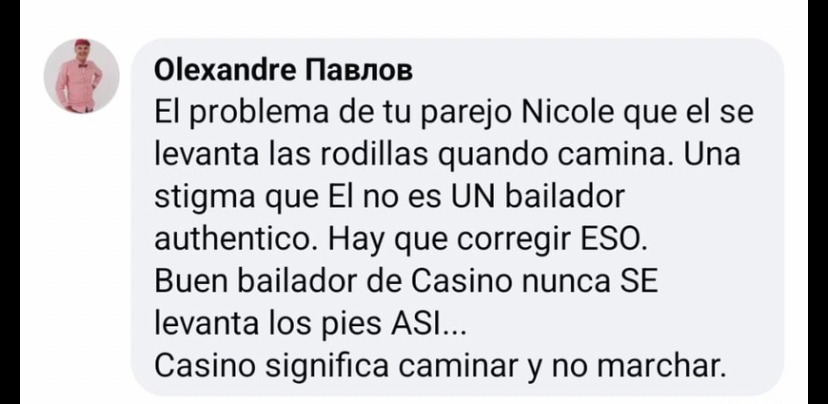
What we see here is not just technical feedback, but a worldview. One in which a highly specific interpretation of the dance is treated as the standard against which all others are judged.
In that sense, MCC does more than teach casino—it reshapes how dancers perceive it. And once that perception takes hold, it naturally leads back to the method itself, reinforcing a cycle in which the system remains the primary reference point while other ways of dancing—particularly those of Cubans outside of it—are dismissed or misunderstood.
Incentive to not resolve the problem
If the initial problem that draws people to MCC is the inability to dance casino socially—to navigate a real dance floor, with real partners, in real time—then the question becomes: does the system actually resolve that problem?
Or does it redirect it?
Because what often happens is that dancers trained primarily within MCC become highly competent… within the logic of MCC. They can execute patterns, recognize structures, and interact fluently with others who share that same training. But once they step outside of that ecosystem, that fluency does not always translate.
The issue is not lack of ability. It is lack of adaptability.
Casino, as it is danced socially, requires constant negotiation: with the partner, with the music, with the space, with the unpredictability of other dancers. It is not governed by a single internal logic, but by many overlapping ones. When a dancer is trained primarily within a closed system, that adaptability can be underdeveloped—not because it is impossible to learn, but because it is not the central priority of the method.
This is why dancers trained solely within MCC often run into the same limitation as those taught fragments of performance (see Case Study 2). It is, in many ways, the other side of the same coin! In social settings, they can become frustrated when a partner does not respond as expected—not because the partner lacks ability, but because the partner is not operating within the same internal logic. This becomes especially visible when MCC-trained dancers attempt to dance with Cubans who have learned the dance socially.
In those moments, instead of the system expanding to account for variability, the explanation offered by the “guru” often contracts. The issue is not framed as a limitation of the method, but as a limitation of the other dancers: they do not know how to dance “correctly,” they are unrefined, they are inconsistent. The conclusion, implicitly or explicitly, is the same—the problem is not the system.
And so the solution is also the same: more MCC! Because MCC is not enough. There has to be MCC 2.0, 3.0, and so on.
In other words, more structure. More refinement. More internal logic. The answer to the friction between the system and reality is not adaptation to reality, but further investment in the system itself. The method presents itself as both the diagnosis and the cure. At that point, the original problem has not been resolved—it has been contained.
MCC does not ultimately seek to prepare dancers for the full variability of casino as a lived, social practice–though it claims that it will teach you to dance socially. Instead, it offers a compelling alternative: a coherent identity, a structured pathway, and a community that reinforces both. And within that system, one can improve indefinitely.
But what remains increasingly absent from that process are the very things that gave rise to the dance in the first place: Cuban social context, Cuban culture—and Cubans themselves.
What takes their place is the brand–el sello, as Marrero calls it. The grift.
Towards a Way Out
If the grift works, it is not simply because of those who perpetuate it. It works because it is easy.
It does not ask the individual to do any real work on themselves. It does not challenge their assumptions, their biases, or their limited understanding of the culture they are engaging with. Instead, it does the opposite. It affirms what they already believe. It tells them that the problem lies elsewhere—other dancers, other instructors, even the culture itself. It makes them feel seen, validated, understood.
And that is precisely why it is so effective.
Because the alternative is harder.
It is not easy to be told that you might have a distorted or incomplete perception of Cubans. It is not easy to accept that learning a dance also means confronting your own limitations in understanding the people who created it. That kind of work is personal. It requires humility. It requires time. And, more importantly, it requires a willingness to be uncomfortable.
But that is exactly where the solution begins.
If there is a way out of the grift, it starts with shifting the focus away from consuming the dance and toward engaging with the people behind it.
Put simply: You need to be more in touch with Cubans.
Because when Cuban dance exists only as something you learn in a class, at a congress, or through a method, it becomes easy to reshape it, simplify it, or misunderstand it.
But when Cubans are part of the picture, that changes.
When you are in contact with Cubans—when you talk to them, dance with them, listen to them—you begin to see the limits of any one system or method. You realize that there is no single “correct” way to dance casino, that the dance is full of variation, contradiction, and personal expression. You start to understand that what you have learned is not the dance, but a version of it.
And once you see Cubans not as abstract references, but as real people—with different perspectives, different styles, different relationships to the dance—you can no longer reduce casino to a product. You can no longer approach it as something to simply consume.
Ultimately, that is what disrupts the grift. Not just better information. Not just better instruction.
But a shift in orientation.
From product, to people.
If you are reading this, chances are you have followed this blog for some time now. If that is the case, I want to truly thank you for still following. 2025 was a year of big changes. The number of followers on the blog’s Facebook skyrocketed to 50 thousand, and I did not know how to handle it. Without realizing it until it was too late, I found myself spending way too much time online, making videos and posts, at the expense of spending that time with my two little kids. So I made the decision to quit. Quite honestly, I have not missed the “fame” one bit. Converserly, I have throughouly enjoyed all the time I now have for my kids, away from the enticing claws of social media.
I also felt I had lost my way, caught up in the vortex of social media “stardom”. I found myself missing the old days, the simpler times, when I would write something; some people would read it; every now and then I would get an email or comment with a follow-up question about something I had written. So this feels right.
I don’t know how often I will be writing. Maybe the next piece will come in a week, or two years. When I write something, it’s usually because the idea won’t leave my head until I sit down to flesh it out. I cannot concentrate on anything else. This is certainly what happened with this article.
Until that happens again, all I can promise is that this blog and its contents will stay online.
Until next time. As always, thank you for your readership.
Notes
- On this topic, I highly recommend reading the following articles if you have not done so already: What the history of Latin dances abroad can teach us about casino–and Cuban salsa, and Recognizing “Cuban Salsa” as a Dance, and What It Means for the Dance of Casino ↩︎
- See articcles such as Clarifying Misconceptions: Is There a Cuban Dance Called “Timba”? and interviews such as the one with Julio Montero:
Towards a Healthy Relationship with Cuban Culture and Cubans ↩︎ - Definitionally, the manosphere refers to “a loose network of communities that claim to address men’s struggles – dating, fitness or fatherhood, for example – but often promote harmful advice and attitudes”. See full article here. ↩︎
- Examples of this are Kubasoy, a dance school that caters to teaching Cubans and which I have featured on this blog. Read more about Kubasoy here: Betting on the Cuban People: Talking to Herson Fernández Machado, creator of Kubasoy, As of last year, Yanek Revilla held free casino classes at a park in Santiago de Cuba. And close friend of mine, the Casineros del Este, also hold more formal classes for the Cuban people and their own social in Havana. ↩︎
- See articles such as Are Artists Destroying Casno as a Social Dance and Clarifying Misconceptions: Is There a Cuban Dance Called “Timba”? ↩︎
- I have written at lenght about the MCC here: On “MCC” and the Dance of Casino: A Perspective and about my experience with this method and Marrero in this article: My Radicalization Story And How You Can Avoid Hating Dancing Casino. ↩︎
- I have written extensively about this in the article
Cubans Are Not OK With What is Happening to Casino Abroad. They Are Just Not Telling YOU ↩︎


This looks like it will be very interesting. Greetings from Miami/Dania Beach, FLA
Thank you! It is now up. I hope you find it helpful!
This article is AWESOME, my friend! I hope that all is well with you!
A powerful, insightful and timely analysis. Written with the prowess and eloquence of a social scientist. I particularly enjoyed the discussion of case study 3 which is where the essay shines most brightly. The suggestions for a way out are cogent and expressed with both firm clarity and compassion. Reading this piece makes one wonder whether and how the grifter frame of analysis might be applied to the production and reception of danceable Cuban music.
All these criticisms of grift in the Cuban dance scene are undoubtedly true. It’s the remedy that fails to satisfy because this grift is a symptom with unaddressed deeper causes. You’ll find these in the relationships of the dance grifters with their audience, the music they use as a backdrop and the grifters purveying this music, along with the dire state of the world in which this all takes place.
I’ll put this as briefly as I can, but to explain my use of the term “art”, first I must return to an old bone of contention. Daybert does not believe popular dance to be an art form as it is not conscious of itself as such. I have elsewhere strongly disagreed with this and to earlier comments would add mention of the Surrealist movement. This, the greatest artistic movement of the 20th century, actively sought to remove or reduce the effects of consciousness and its distorting secondary elaboration from art, through use of techniques such as automatic writing. One could say that, contrary to Daybert’s definition of art as being determined by the artists’ own definition of their work as art, the more self-conscious the “artist” contrives to be, the less they create genuine art and the more pretentious they instead become. It is for that reason that so much art- music and dance included- uses code that not even the artist understands consciously, to evade the sanitising edits of consciousness to the unconscious.
To carry genuine sentiment arising from our social condition- the object of all artistic culture- that artistic culture must connect to and express our relationship with contemporary reality. Neither the specific forms of Casino dance, of the Son and Timba music, nor their Cuban roots, exempt them from that general law. Instead, we find in “Cuba” no less than the competing brands of “Latin”, a narcissistic tendency in the social strata drawn to it, the desire to distract, insulate from, self-aggrandise, and to deny social reality, the catastrophe engulfing humanity once again. “Latin” has become a milieu of anti-art.
Talking to Cubans, who in any case so often have a stake in the grift, is a remedy for nothing. To put Casino into perspective, it became a national dance in Cuba through a literacy campaign and the state provision of resources to promote popular culture. ENA, likewise, provided a unique pool of world class writers, arrangers and musicians who shared much of the lives of other Cubans, which placed them well to express those lives in their music. Within the severe limitations inherent to a bourgeois nationalist framework in the epoch of imperialism, culture was flowering in Cuba, as it was throughout the Western world. In the time of the Special Period, though it presented no solution, Timba nevertheless spoke to the lives of ordinary Cubans. I don’t believe that is still the case.
The inexorable unfolding of global economic processes lead us today to the opening stages of a third world war, the universal decay of democratic norms- most sharply expressed in the United States, uncontained lawlessness in the world’s ruling oligarchies, historic inequality in wealth and the nationalist regime under which Casino flourished, about to succumb to foreign aggression and its own contradictions. One finds in the global network of Cuban “Cuba” grifters, no shortage of people who discard everything progressive within the Castroite period of Cuban history while clinging to its reactionary and self-defeating nationalism. They have discarded the baby and kept the bath water.
There’s an elephant in the room, the social content of every contemporary cultural form internationally. No cultural form will revive itself without addressing our condition and becoming part of the struggle against that decay, as did the Surrealist movement. Global capitalism is in terminal decay and actually destroying the basis of human civilisation on this planet. In this context, the endless workshops, congresses, and all manner of novelties peddle “transformative experiences”, pretend it isn’t happening, express the trite emptiness of narcissism- a contratiempo, on the one or two or three or four, Miami style, New York Mambo, “Bachata” or Salsa or Casino, it matters not.
Structure is a means to an end. The “transformative experience” is not in yourself or in any dance structure or movement vocabulary. It’s in selflessly facing the world and the enormous challenges it presents, alongside your brothers and sisters. That is the only way to lend soul to whatever way you want to dance.
Thanks for articulating so well what I have been starting to feel as someone trying to learn casino for 4 years now